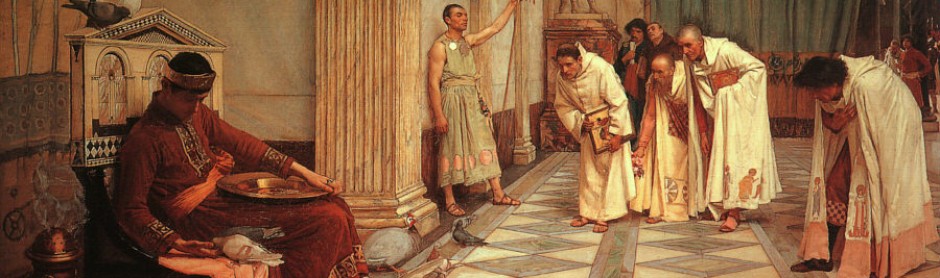
Faustian Latin VIII – Faustus’ Oath

It seems best to divide the text (I.2.230-34) into convenient pieces, number them for easy reference (and speaking), and interleave text and translation, with all the notes below:

1. Sint míhi déi Acheróntis propítii!

May the gods of Acheron be favorable to me!

2. Váleat númen tríplex Jehóvae!

Goodbye, threefold power of Jehovah!

3. Ígnei, aérii, aquátici, terréni spíritus, salvéte!

Fiery, airy, watery, earthy spirits, all hail!

4. Oriéntis prínceps Lúcifer,

Lucifer, Prince of the East,

5. Beélzebub, inférni ardéntis monárcha,

Beelzebub, monarch of burning Hell,

6. et Demogórgon, pròpitiámus vos,

and Demogorgon, we ask your favor,

7. ut appáreat et súrgat Mephistóphilés! Quid tu moráris?

that Mephistophiles may appear and rise up! Why do you delay?

8. Per Jehóvam, Gehénnam, et consecrátam áquam quam nunc spárgo,

By Jehovah, Gehenna, and the consecrated water which I now sprinkle,

9. signúmque crúcis quod nunc fácio,

and the sign of the cross which I now make,

10. et per vóta nóstra,

and by our vows,

11. ípse nunc súrgat nóbis dicátus Mephistóphilés!

May Mephistophiles himself now rise up, dedicated to us!

My voice-recording (such as it is) is in three parts: 1-3, 4-7, 8-11. I need to find out how to link them from the page so readers can read and hear simultaneously. But that will have to wait a few hours, since it’s almost time for The Devil’s Charter, another Jacobethan play about selling one’s soul for power (in this case, the Papacy), performed by the same troupe that is doing Doctor Faustus in two weeks, and asked me for advice on the Latin.

Notes:

  1. Acheron is one of the rivers of the Underworld, so ‘the gods of Acheron’ are either Pagan underworld gods or Christian devils or (most likely) a bit of each. I believe some Christian theologians identified the two.
  2. Rather like ‘fare well’ in English, Valeat means both ‘be strong’ and ‘goodbye’, and it’s hard to decide between the two here. It can hardly mean both, since ‘be strong’ is a compliment, ‘goodbye’ a mild insult – almost ‘go away’. I prefer ‘goodbye’ because he says ‘hello’ (salvete) to the spirits of the Four Elements in the very next line. God’s ‘threefold’ power obviously refers to the Trinity.
  3. The early editions have garbled a lot of the Latin. Aquatani is not good Latin for ‘watery’. Tucker Booke changed it to aquatici and Greg added terreni ‘earthy’ so all four elements would be present. It looks to me like Aquatani merged the beginning of aquatici with the end of terreni.
  4. Lucifer was inserted by Greg, since he is called ‘Prince of the East’ in the Bible, and Lucifer and Beelzebub are different characters later on in this play, at least in the stage direction in II.iii, though I don’t think Beelzebub actually speaks there.
  5. Without Lucifer in the previous line, it would be very difficult to tell whether this is all in apposition or not.
  6. I assume Demogorgon is a third devil, to make a mocking Satanic anti-Trinity. I don’t think Demogorgon is another name for Mephistophiles, who seems to be of lower rank, a mere captain or colonel in the Army of Darkness. ‘Your’ is plural, but I didn’t think anyone would want ‘y’all’s’ even in the subtitles of an Elizabethan play
  7. The reading of the early editions is nonsense, and quid tu moraris? is Bullen’s plausible conjecture for quod tumeraris. Here the ‘you’ is singular, so he’s speaking to Mephistophiles alone. There should be a pause before the question, as he waits for Mephistophiles to appear. More colloquially: ‘What are you waiting for?’
  8. This is an odd mixture of holy (Jehovah, holy water) and unholy (Gehenna is more or less Hell). I suppose Faustus is as confused about magic as he is about philosophy.
  9. I suspect this is some kind of backwards or twisted Sign of the Anti-Cross: a normal one would hardly be appropriate here. Then again, see previous note: maybe Faustus makes a normal Sign of the Cross unthinkingly, from habit.
  10. Here and in the next line ‘our’ and ‘us’ mean ‘my’ and ‘me’: Latin uses the ‘royal We’ all the time, without any royal or pretentious implications. The vota are vows, promises, wishes, all wrapped up in one word.
  11. ‘Himself’ (ipse) means ‘in person’: Faustus wants Mephistophiles, not some go-between messenger devil with no power to deal – not that Mephistophiles has that power, as it turns out. The meaning of dicatus is difficult: ‘dedicated to us (=me)’ must mean something like ‘at my command’ plus ‘to serve me’.

Anything else?

Posted in Blackfriars, English Literature | Tagged , , | 1 Comment

Faustian Latin VII – some bits I missed, one of them not Latin

I will get to Faustus’ oath soon, but in the mean time here are three bits I missed. At some point, I hope to put these all together on one page, in order, with line references to the various editions, since those are highly variable (these numbers are from Bevington & Rasmussen’s Revels edition):

I.1.12:

On kai me on

This is not Latin, but Classical (and Philosophical) Greek. It would be spelled like this in Greek script: ὂν καὶ μὴ όν, but that’s more than you need to know to pronounce it. (Several early editions have ‘economy’ but that is just a wrong guess by a confused typesetter.) The pronunciation is easy: On Kye May On.

The words mean ‘being and not being’, the subject of some of the more abstruse parts of metaphysics (on, ‘being’ is related to ‘ontology’, kai means ‘and’, and me means ‘not’). Probably all the words except the ‘and’ (kai) should be accented. It should sound something like this.

II.1.29:

Véni véni Mephistóphile.

This is not the same veni as in Caesar’s famous Veni, vidi, vici. That veni has a long E and means ‘I came’. Faustus’ veni has a short E and is imperative singular, a command addressed to one person: ‘come’. (One verb having two forms that are spelled the same but pronounced differently is not unheard of in English, where ‘read’ as in ‘I read books’ rhymes with ‘reed’ when it’s present tense, with ‘red’ when it’s past tense.) He’s just telling Mephistophilis to come to him, repeating the verb to show urgency or impatience: “Come, come, Mephistophilis”. The dropped S on the name is not classical Latin, but is the sort of thing Greek and Latin do with vocatives. The whole thing should sound like this.

II.3.57:

Intelligéntia.

The meaning is easy: ‘intelligence’, meaning presumably that an angel is in charge of turning each sphere, they don’t just turn by themselves. For pronunciations, it’s hard to say whether Marlowe would have said ‘intelligént-ee-yuh’ like modern Latinists or ‘intelligénts-ee-yuh’. More likely the latter, I think, and it might be more intelligible to the audience, too. Here’s my version.

Posted in Blackfriars, English Literature | Tagged , , | 2 Comments

Faustian Latin VI – Faustus (all except the oath)

Most of the Latin in Doctor Faustus is spoken by Faustus himself, and some he glosses himself:

I.1.35:

Béne dissérere est fínis lógices.

In the next line, Faustus asks “Is to dispute well logic’s chiefest end?” which just rephrases this as a question. Literally, it means “To dispute well is logic’s end” (‘end’ meaning ‘aim, goal, purpose’ – there’s no ‘chiefest’ in the Latin). I believe Marlowe would have used soft G and soft C in the last word, like this. The Romans would have used hard G (not = J) and hard C (= K), but Marlowe didn’t know that. Of course English ‘logic’ has soft G and hard C, so logices is going to sound awkward however it’s pronounced.

I.1.41:

Úbi désinit philósophus, íbi íncipit médicus.

This means “Where the philosopher stops, the doctor begins”, which has always puzzled me: does it mean that the philosopher only theorizes, while the doctor acts on his understanding of human nature? (Rather like Marx’s “philosophers have only interpreted the world in various ways, the point is to change it”, but applied to single human beings rather than the whole world?) It should sound like this.

I.1.44:

Súmmum bónum medicínae sánitas.

This means “The highest good of medicine is health”, and Faustus paraphrases it in the next line (“The end of physic is our body’s health”). It sounds like this.

I.1.56:

Si úna eadémque res legátur duóbus,
álter rem, álter valórem réi, et cétera.

This is the kind of obvious, common-sense law that anyone could figure out without going to law school or even reading a law book: “If one and the same thing is left/willed/bequeathed to two [heirs], one [should receive] the thing, the other the value of the thing, etcetera” – it’s not actually a complete sentence, because Faustus is too bored to finish it. (Verbs usually go last in Latin, and this one is omitted, so “one the thing, the other the value of the thing . . . – duh! ‘should receive’, but I can’t be bothered to finish the thought!” It should sound something like this, but maybe more bored and perfunctory.

I.1.58:

Èxhaerèditáre fílium non pótest páter, nísi, et cétera.

This is not boring obvious law, like the previous example, but tedious technical law: “A father cannot disinherit a son unless” – presumably, unless he makes the statement in just the right technical form, with the proper number of witnesses, to avoid legal challenges. Faustus interrupts himself because the details are boring, though not obvious to non-lawyers. It should sound something like this, but again more bored and impatient.

I.1.66:

Stipéndium peccáti mors est.

As Faustus says, this means “The reward of sin is death” (or “the payment” – stipendium is related to ‘stipend’.) Good Biblical Latin, from Romans 6:23, but taken out of context. It sounds like this.

I.1.68:

Si peccásse negámus, fállimur,
et núlla est in nóbis véritas.

Again, Faustus paraphrases: “If we say that we have no sin, we deceive ourselves, and there is no truth in us”. Again, a direct Biblical quotation, from John 1:8. Fallimur could also be translated “we are deceived” (by someone else – not hard to guess who that would be) or just “we are mistaken”.) This should sound something like this.

I.2.230-34:

(Faustus’ long complex oath will be analyzed in my next post.)

I.3.246:

Quin rédis, Mèphistópheles, frátris imágine?

“Why don’t you return, Mephisopheles, in the image of a friar?” (Literally, “of a brother”, but he means the religious kind.) It sounds something like this.

II.1.461:

Cònsummátum est.

“It is finished.” (The Latin participle is the same word as “consummated” in English, but “It is consummated” sounds a little too sexual and marital to me, unless you want to go that way in depicting the relation between Faustus and Mephistopheles.) As commentators note, this is a blasphemous quotation of the last words of Christ on the cross. It should sound like this.

II.1.464:

Hómo fúge.

Homo is not ‘man’ as in ‘male human being’ but ‘man’ as in ‘mankind’ – it means a human of either gender. (‘Human’ and ‘humane’ both comes from the Latin adjective corresponding to homo, while ‘virile’ comes from the adjective for vir, which is the Latin word for male human being. The whole does-man-mean-male-or-include-both-sexes question is entirely a problem of the English language, not Latin.)

The sentence is hard to translate plausibly: “Flee, human”? – sounds like an alien in a bad sci-fi movie. “Flee, person”? – awkward. “Flee, man”? – misleading as to gender and awkwardly hippie-sounding. However translated, it should probably sound something like this.

II.3.623:

Sítu et témpore?

“In place and time?” – the phrase is technical-scientific-philosophical. (Situ is related to English ‘site’ and tempore to ‘temporal’, ‘temporary’, and ‘contemporary’.) It should sound like this.

V.2.1269:

O lénte, lénte cúrrite, nóctis équi!

As with Mephistopheles’ first quotation, this is an entire line of Latin verse, specifically Ovid, Amores 1.13.40, in which Ovid (or his poetic persona) asks the goddess Night (or Dawn? not quite clear) to extend the night so he and his girlfriend will have more time for love-making. Literally, “Run slowly, slowly, o horses of the night” (or “of Night” if that’s the goddess meant) – winged horses pulling a divine chariot – very pagan and not at all Christian.

Following Roman rules for a so-called elegiac pentameter, the rhythm is long-long-long-long-long long-short-short-long-short-short-long, and sounds something like this. If we give the words their proper prose accents, it (fortuitously) makes a decent English-style iambic pentameter, with an extra syllable in the fourth foot and another at the end. (Do they still call that a feminine ending?) It would sound something like this. I prefer the latter for Marlowe, and they don’t sound as different as I would have thought.

– – – – – – – – – – – – – – – – – – – – – – – – – – – –

As always, questions or remarks may be submitted as comments. The first will be moderated, but once you’ve had one approved, they will go through immediately, unless you do something to make me ban you.

Posted in Blackfriars, English Literature | Tagged , , | Leave a comment

Faustian Latin V – Mephistopheles

Mephistopheles has three bits of Latin:

II.1.429:

Solámen míseris sócios habuísse dolóris.

Solamen is ‘consolation’ – relative, not interrogative – miseris is ‘to/for the wretched/miserable’, socios (related to ‘social, society, associate’) is ‘companions, associates, allies’ (plural direct object), habuisse is a perfect infinitive ‘to have had’, and doloris is ‘of pain, sorrow, trouble’. Put together, it means ‘(it is) a consolation to the [plural] wretched to have had companions of [=in] sorrow’, pretty much ‘misery loves company’ but more concrete (‘miserable/wretched people’ for ‘misery’) and with a past tense added.

The line is a complete Latin dactylic hexameter, which mixes spondees with the dactyls in the first five feet, and ends with a spondee: in this case we have one spondee, then four dactyls, then a spondee to end the line. It looks like a quotation, but if so the author is unknown: perhaps Marlowe composed it himself. As with Wagner’s Qui mihi discipulus, we can read it according to the Latin rules, like this, or we can give the words their proper prose accents, like this. The second half sounds pretty much the same either way.

II.3.639:

Per inaequálem mótum respéctu tótius.

This is a tedious bit of scholastic Latin prose, pseudoscientific jargon that doesn’t really answer Faustus’ question. Why do different planets pass each other in their courses around the sun, or even sometimes appear to back up (‘retrograde motion’ as in the All’s Well joke)? ‘Through [= because of] the unequal motion in respect of the whole’. Mephistopheles doesn’t know enough, or care enough, to give a more precise scientific answer. It should sound something like this.

III.1.793:

Súmmum bónum.

SUH-muhm BO-nuhm. This is two trochees, and the Us all sound like the U in English ‘put’ or ‘push’. Summum is ‘highest’ (as in ‘summit’ and ‘sum’ and ‘summary’), and bonum is ‘good’ (= ‘good thing’ – neuter adjective used as a noun, as in English). It’s philosophical Latin: the ‘highest good’ is whatever is most important in life – pleasure for Epicureans, duty for Stoics, God’s will (I think) for Christians, and so on. It should sound something like this.

Posted in Blackfriars, English Literature | Tagged , , | Leave a comment

Faustian Latin German – Wagner again

Should Faustus’ servant’s name be pronounced like Richard Wagner’s last name (VAHG-ner) or like Honus or Robert or Lindsay Wagner’s (WAG-ner)? I’ve heard it both ways in productions. Would Marlowe have known the basic German pronunciation? Presumably: between his mysterious travels on the continent and his use of the German Faustbuch as a source, he would surely have picked up so basic a fact of German as the pronunciation of W. Would he have preferred the German pronunciation in writing for an English audience? That’s a difficult question. I’ve always preferred the Anglicized pronunciation, but have to admit that I can think of no good argument either way.

Posted in Blackfriars, English Literature | Tagged , , | Leave a comment

Faustian Latin IV – Wagner

Wagner has has two bits of Latin, but each raises a mildly tricky question of pronunciation:

I.4.338:

Qui míhi discípulus.

Kwee MEE-hee diss-KIP-uh-luss. Qui is ‘who’ – relative, not interrogative – mihi is ‘to/for me’, and discipulus is ‘student, pupil’ (same word as English ‘disciple’, but with no religious implications in Latin). Put together, it means ‘(you) who (are) my student’. Commentators note that this is the opening phrase of a Latin poem by William Lyly (grandfather of John Lyly, the playwright) used to teach elementary Latin grammar.

As for pronunciation, this is Renaissance Latin, but follows the Classical rules, where the rhythm is based on long and short syllables, not stressed and unstressed. The rhythm is dactylic (long-short-short), the commonest classical meter, and this phrase is two and a half dactyls: long-short-short-long-short-short-long. If we ignore the word-accents and emphasize the dactylic rhythm, it would sound something like this. Romans probably didn’t do that, any more than English-speakers read every line of Shakespeare duh-DUM-duh-DUM-duh-DUM-duh-DUM-duh-DUM. Then again, Marlowe and his contemporaries probably did read it that way. If we stress the word accents, making the lengths of the syllables secondary, it will sound something like this – not as different as I would have expected. Given Wagner’s pretentious ignorance of Latin, you probably don’t want to recite it too competently.

I.4.385:

Quási vestígiis nóstris insístere.

KWAH-see Vest-I-jee-eese NOSS-treese in-SIS-teh-reh. Quasi is ‘as if’ – still used in English compounds – vestigiis is ‘footsteps, footprints’ (related to English ‘vestiges’ and ‘investigate’), nostris is ‘our’, and insistere is an infinitive, ‘to tread on, step on, stand on’ (related to ‘insist’, but with a purely physical meaning). The whole phrase (prose this time) means ‘as if to follow in our footsteps’ – ‘our’ probably means ‘my’ (as often in Latin), and ‘as if’ probably implies ‘if I were making literal footsteps in soft dirt, you should be putting your feet in the actual tracks I make’ – like a good servant. It should sound something like this.

Note: I would not use the restored classical pronunciation, with V sounding like W and G always hard (as in ‘get’ and ‘give’). Two reasons: (a) Marlowe would not have used it, and (b) contemporary audiences are more likely to recognize vestigiis as being related to ‘vestiges’ if it has hard V and soft G like the English word.

Posted in Blackfriars, English Literature | Tagged , , | Leave a comment

Faustian Latin III – 1st Scholar

The 1st Scholar has only one tiny bit of Latin:

I.1.186:

Sic próbo.

SEEK PRO-bo. Sic is ‘thus’ – still used in square brackets to show that something inside quotation marks was misspelled by the author, not the editor. Probo is ‘I prove’ or ‘I approve’. The whole phrase is what a proud scholar would say in clinching his argument, pretty much like Q.E.D. It should sound something like this.

Posted in Blackfriars, English Literature | Tagged , | Leave a comment

Faustian Latin II – The Friars

When Faustus and Mephistophilis disrupt the Pope’s dinner in Act III, the monks who curse them have two bits of Latin, the first repeated half a dozen times:

III.1.831:

Màledícat Dóminus.

This is basically three and a half trochees: Mah-leh-DEE-caht DOM-i-Nuss. Dominus is ‘Lord’ or ‘the Lord’ – there’s no definite or indefinite article in Latin, so it can be either. Maledicat is 3rd person singular present subjunctive active of male-dicere, ‘to speak badly (of someone), to curse’, so the whole phrase means ‘May the Lord curse (object unspecified)’. It’s an inversion of the usual prayer Benedicat Dominus, ‘(May) God bless (x)’. The phrase should sound something like this. I would be very tempted to make it sound like a Gregorian chant, something like this. I think I’ve heard it done that way in other productions.

III.1.838:

Et Ómnes Sáncti.

This is basically two and a half iambs: et OM-nayce SAHNK-tee. Et is ‘and’, omnes ‘all’, sancti ‘saints’ (of both sexes), so ‘And all the saints’. It’s not a complete sentence, but the previous curse is implied: ‘(May the Lord curse him) and (may) all the saints (curse him, too)’. Here’s the plain prose reading. And here’s the Gregorian chant reading. I trust trained actors can make that sound a lot better.

Posted in Blackfriars, English Literature | Tagged , , | Leave a comment

Faustian Latin I – General Remarks

A few months ago, I promised some grad students putting on a production of Marlowe’s Doctor Faustus that I would help them with the Latin. Now that I’m back from Germany – more on that later – it’s time I kept that promise.

How to pronounce the Latin in an Elizabethan play is not an easy question to answer. For one thing, Marlowe and his contemporaries knew at least three different kinds of Latin, and Marlowe uses all three, though they’re not always clearly distinguished:

  1. Classical quotations: most famously, the line of Ovid’s Amores Faustus speaks just before he is damned.
  2. Ecclesiastical (‘Church’) Latin: most obviously, the bits spoken by the monks who curse Faustus after he disrupts the Pope’s meal.
  3. Scholastic Latin: more generic, used by educated contemporaries for scholarly, scientific, or philosophical communication.

In upcoming posts, I will mark primary stress with an acute accent, secondary with grave, and underline the long vowels, since HTML handles that a lot better than trying to put a long mark and an accent above the same vowel. I will also include links to .wav file recordings in which I recite the lines and phrases to illustrate my recommended pronunciations. Warning: I am just beginning to experiment with recording software and hardware (Audacity and a Snowball microphone) – not to mention dramatic recitation – so these are likely to be more informative than entertaining. Comments and suggestions are of course welcome.

Posted in Blackfriars, English Literature | Tagged , , | Leave a comment

Help needed: German bookstores

Can anyone recommend bookstores for new and used Greek and Latin texts and commentaries in Berlin, Leipzig, Munich, or Vienna? I will be visiting all four cities over the next month. Zentralantiquariat Leipzig is already on my list: it turns up quite often in my ABE search results. Will university bookstores have a good variety of new texts? Or only those assigned for specific classes?

By the way, I am now tweeting as @Curculiunculus and have asked the same questions there, if it’s easier to answer there.

Posted in Announcements | Leave a comment

Curculio 6: Two Adjectives in Seneca’s Agamemnon

How’s that for a boring title?

As a continuation of my experiment with publishing original scholarship on this site, I have just uploaded an eight-page PDF containing two conjectures on the text of Seneca’s Agamemnon, titled as above (link). (I thought of calling it ‘Ino the Answer’, but that only applies to the first half.) Feedback on the substance or expression of any of these notes, listed in the right-hand column, may be left as blog comments. Your first will be moderated, but once you’ve had one approved, others will be approved automatically, unless you behave so badly that I am forced to blacklist you. I don’t expect that to happen often. My reasons for and against publishing ‘Microscholarship’ in this way will be published soon – on this site, of course. So far I’ve thought of 8 pros and 3 cons.

Here’s a question: should I format all the papers for HTML as well as PDF? Those with numerous footnotes take a lot of time to convert: is it worth it, from the reader’s point of view? So far, that’s the two that contain emendations, this and Curculio 2, on Cymbeline, but that may be coincidental. Textual criticism often lends itself to succinctness.

Posted in Culture: Plays, Curculio: Classics, Curculio: Latin, Latin Literature | Tagged , | Leave a comment

Curculio 5: Worst. Endearment. Ever.

Peter Davidson’s Poetry and Revolution: An Anthology of British and Irish Verse 1625-1660 (Oxford, 1998) includes a rather dull love-poem (number 36) by “T.C.”, most likely Thomas Cary, “Gentleman of the Bedchamber to Charles I” (516). The untitled poetic dialogue begins:

Tell me, Eutresia, since my fate
And thy more powerfull Forme decrees
My heart an Immolation at thy Shrine,
. . .

In the ‘Notes on the Text’ in the back of the book (516), Davidson records that some manuscripts call the addressee ‘Eutresia’, at least one ‘Utrechia’. The note below the text reads: “1 Eutresia ‘Utrechia’ MS (Greek) ‘beautiful hair'”, which is a bit confusing: which name is supposed to mean ‘beautiful hair’? Could ‘Utrechia’ be meant for ‘Eutrichia’ or something similar? (I see nothing in the poem to justify an allusion to the Dutch city of Utrecht.) The Greek adjective meaning ‘with beautiful hair’ is normally ‘euthrix’ in the nominative, sometimes feminine ‘eutriche’ or possibly ‘eutricha’. ‘Utrichia’ may be close enough to the last, if U- can stand for Eu- and we can attribute the -i- to euphony rather than nounness.

But what of Eutresia, the name Davidson prints in his text? I see no way to make that mean anything to do with hair. It would be a properly-formed Greek noun meaning ‘well-holedness’, the quality of being equipped with one or more excellent holes or orifices: not a name anyone this side of Lord Rochester, or Martial in one of his darker moods, would give to an enemy, much less a mistress. Neither ‘eutresia’ nor for that matter ‘dystresia’ is included in the OED, but ‘atresia’, “from Greek ἄτρητος not perforated”, is attested with the meaning “occlusion or closure of a natural channel of the body” since 1807. Biliary atresia is a common birth defect.

A mountainous region near the center of the Peloponnese, north and east of Megalopolis, was called Eutresia in ancient times. I do not know whether it was named that for an abundance of springs, or caves, or both, and an Internet search for caves in Greece does not indicate any disproportionate number of them in Eutresia. The Greek adjective ‘eutretos’ (εὔτρητος), meaning literally “well-holed”, is found in a wide range of authors, describing (for instance) Hera’s pierced earlobes (Iliad 14.182), wind instruments, the soil of a well-worked garden, and a sponge. I suppose Cary’s mistress, if not imaginary, could console herself with the thought that at least he didn’t call her Dystresia.

(PDF Version)

Posted in Curculio: English, English Literature, Etymology, Orbilius | Tagged , | 1 Comment

“Bacon and Eggs”

Laudator Temporis Acti quotes an amusing poem from 1931 by A. P. Herbert on the British fondness for bacon and eggs. There is an equally-amusing country song by the Lovett Sisters saying much the same about Americans in 1954. Here are the lyrics, transcribed and punctuated by me:

You can walk into a rest’rant, at breakfast-time you’ll see
a bunch of people comin’ in as hungry as can be.
They sit and read the menu like it was the morning news,
and all the time the waitress knows just what they’re gonna choose:

Chorus:
       “Bacon and eggs”, “bacon and eggs” –
       that’s what they’ll always say.
       “Oh, gimme bacon and eggs”, “bacon and eggs” –
       she hears it a hundred times a day.

They get a glass of water and a menu from the rack.
They read it on the front and then they’ll read it on the back
About the time you think they oughta have it memorized,
they lay it down and order every waitress a surprise:

(Chorus)

I wonder what they’d do if all the pigs and chickens died.
Breakfast wouldn’t be the same, no matter what they tried.
But pigs will still make little pigs and hens are gonna lay,
and waitresses will wait and wait, and always hear them say:

(Chorus)

If you want to hear the song actually sung, it’s on an album entitled “Gals of the ‘Big D’ Jamboree”.

Posted in Music | Tagged , , | Leave a comment

Walter Scott Anagrammatized

Laudator Temporis Acti has an interesting post on Sir Walter Scott’s library. If you haven’t already read it, go and do so before continuing.

Done? OK, let’s continue.

I was naturally curious about the anagram, wondering how Scott’s library motto, clausus tutus ero, worked as “an anagram of his name in Latin”. It took a little while, but I eventually figured out how to equate the two. Quite a few adjustments are necessary, not least because Latin has no W:

  1. As “his name in Latin” implies, we must add -US to the end of both names. With four Us in the motto and none in the name, that’s an obvious first step. (Should we treat U and V as equivalent and make that -VS rather than -US? Yes: more on this below.)
  2. With only two Ts in the motto and three in the name, we have to omit the second T in Scott, making the Latin ‘Scotus’, as in Duns Scotus, not ‘Scottus’. Whether ‘Scotus’ would have been pronounced with a long or short O, I do not know.
  3. We cannot make Walter ‘Gualterius’, the usual Latin equivalent, because there’s no G in the motto, and we need two more Us. Instead, we must make the W – not allowed in Latin – into two Vs, as often seen in early texts of Shakespeare. This is where the V-U equivalence comes in: W may be called ‘double U’, but I’ve always seen it spelled double V when divided.

To sum up, the only way I can see to make ‘Walter Scott’ and ‘clausus tutus ero’ anagrammatically equivalent is to spell them VVALTERVS SCOTVS and CLAVSVS TVTVS ERO.

Posted in English Literature | Tagged , , , , | 5 Comments

Announcement: Juvenal Reformatted

Some time between 1998 and 2000 – I really should have kept better records – I uploaded a complete on-line text of Juvenal’s Satires, with brief apparatus criticus and some original conjectures. Though it has not been updated since (I think) 2004, it has won some praise: the new Blackwell’s Companion to Persius and Juvenal (Braund and Osgood, 2012) calls it “excellent” (464), and six of my conjectures are printed in the text of Braund’s Loeb Juvenal (2004), one more in the apparatus.

Unfortunately, the format in particular is showing its age: it was never very attractive, and looks quite repulsive on today’s wider screens. I have therefore reformatted text and commentary in the style of my later texts of Martial IV and Ovid, Heroides I. Just click on ‘Juvenal (1st edition 2000)’ in the right margin. Anyone who wishes to see it in its original ugly format (perhaps as a warning) will find a further link on that page. I call it the “1st edition” because I will very soon begin reediting Juvenal for a second, much improved on-line edition. It will have a fuller apparatus which includes many new conjectures (some mine, some not) and omits or demotes to the apparatus a few older readings that no longer please. It will be done as part of my textual database QLTP, for easy selection and reformatting. Most important, the construction of the text will, I hope, be to some extent interactive. As each satire is uploaded, it will be accompanied by a public on-line textual-interpretative seminar (not a MOOC but a POTIS), in which I will present my Adversaria in blog form, one post per passage or problem discussed, and invite comments and suggestions for the improvement of the text and interpretation of Juvenal. Some of the conjectures I have already published have never been explained in print, some need to be reargued, and I have many questions about passages that I hope others will be able to help me answer. Over the next few years, I plan to do the same work – text plus POTIS – for Persius and the rest of Martial and the Heroides. Watch this space to see what comes first.

By the way, this blog is currently set up so the first comment from any user is held for moderation, so please don’t repost your first comment. However, once the first comment is approved further comments will appear immediately, unless someone is foolish enough to post a comment that earns a place on the blacklist.

Posted in Announcements, Critical Texts, Latin Literature | Tagged , , | Leave a comment

Curculio 4: A Sly Joke in The Alchemist?

Kastril or Kestrel, the ‘angry boy’ of Ben Jonson’s Alchemist, calls his sister his ‘suster’ and says ‘kuss’ for ‘kiss’.1 It is not clear whether this is meant to represent a particular regional dialect, a generalized country accent, or his own personal idiolect: commentators are mostly content to gloss both words for the unwary.2 In IV.iv.91, he reveals his sister’s formal name, Dame Pliant, and in V.iii.38 her first name or (more likely) nickname, when he refers to her as ‘Puss, my suster’. I wonder whether that name contains a sly joke. If he says that his ‘suster’ is named ‘Puss’, does that imply that, in the usual pronunciations of the day, his ‘sister’ would be named ‘Piss’?

Of course, just because Kastril turns I into U does not mean that every U he speaks would be an I in other dialects and idiolects. Still, I doubt that it is entirely coincidental that Jonson gives Dame Pliant a name that is so amusingly obscene if we assume the same vowel-change as in ‘suster’ and ‘kuss’ and translate it back into standard English. I certainly laughed out loud when I first saw the play at the Blackfriars in Staunton in January of 2010 and heard Tyler Moss as Kastril say the line. Then again, Kastril also calls his suster a ‘punk device’ a few lines further on (V.iii.50), and taking ‘punk’ as a mispronunciation of ‘pink’ doesn’t seem to add anything, even with at least four different Early Modern English meanings of ‘pink’ and ‘pinked’ to work with.3 So perhaps the joke I thought I heard was the product of coincidence, not a morsel of Jonsonian wit.4

Notes:

  1. Eleven times and twice, respectively, if I have counted right. Specific line references follow the numeration of Martin Butler’s edition: Selected Plays of Ben Jonson, Volume 2, Cambridge 1989. I will update them if and when I acquire Herford and Simpson’s collected edition.
  2. Probably not the first: if anyone has tried to identify a region in Jonson’s England in which everyone spoke that way, I have not seen it.
  3. Schmidt’s Shakespeare Lexicon and Quotation Dictionary gives “a nonpareil; a nonesuch” and the flower for the noun, “winking, half-shut” (but not the color) for the adjective, and “pierced in small holes, reticulated” for the participle ‘pinked’.
  4. Actors and directors have to decide whether to make the U sound in ‘kuss’ and ‘suster’ resemble that in ‘put’, ‘push’, and ‘Puss’, or that in ‘putt’, ‘gut’, and ‘cut’. My joke works better with the former, and that is the one Moss used in the Blackfriars production.

(PDF Version)

Posted in Blackfriars, Curculio: English, English Literature | Tagged , , , , | 1 Comment

La Rochefoucauld at 400

Yesterday, in honor of La Rochefoucauld’s 400th birthday, I uploaded a page in his honor. Here is the blurb displayed in the left-hand margin, if you’re not sure yet whether you want to click on the link:

“This site displays a random Maxime from the 5th edition of Réflexions ou Sentences et Maximes morales, 1678, the last one overseen by the author: 505 in all, counting the unnumbered épigraphe. Press the button to see another.

“I will eventually add the other 130+ omitted from the 5th edition, as well as a cross-referencer that will allow readers to see any maxime with all of its textual variants, and in all of the different contexts in which it is found in the early editions and manuscripts.

“In the mean time, this should suffice to celebrate La Rochefoucauld’s 400th birthday: today, September 15, 2013.”

I hope all of my readers will have the self-control to resist pushing the button over and over and over for hours, like a monkey, in one of those dismal experiments, that receives a jolt of cocaine or direct stimulation of the pleasure centers of his brain every time he presses the button in his cage.

Posted in French | Tagged | Leave a comment

Best Match of Editor’s Name and Subject?

I’m torn between the Kiss Catullus – the online Catullus edited by Daniel Kiss (link) – and the Hankey Othello (link). Can anyone think of a third?

Possibly the worst match between performer and subject (onomastically, I mean – he does a fine job) is the audiobook of Luther’s translation of the Psalms (link link), read by Reiner Unglaub. (He’s done most or all of the Bible, but those are the only volumes I’ve actually seen.) My German is rusty, but I believe that with one more unaccented letter (‘Reiner Unglaube’) his name would mean ‘pure lack of faith’.

Posted in English Literature, German, Jokes, Latin Literature | Tagged , , , , , | 1 Comment

“There’s Gonna Be Some Changes Made”

I will be announcing some major additions to this site over the next few days. At the same time, I will be drastically reducing the number of categories, using them only for the broadest classifications, and using Tags for more granularity. Subject categories that will be kept are a general Classics category, one for each ancient and modern language (Greek, Latin, English, Spanish, French, etc.), ‘Early Modern English Drama’ for those less interested in the whole history of English, and a few more for broad subject categories (Textual Criticism, Etymology, etc.). Also one for Announcements. Particular authors and works will be Tagged instead, as in my last few posts.

I will also be putting my blogroll back in, with some additions, and links to my web-texts and other features that have been unavailable while I’ve been remodeling.

If you wish to be kept informed of developments, I am now Tweeting as @Curculiunculus, since @Curculio was already taken.

More soon . . . .

Posted in Announcements | Leave a comment

Curculio 3: “Some say the world will end in fire, some say in ice . . .”

. . . and there are definitely worse possibilities. When one language adopts words from another, it sometimes happens that standard spelling changes create a new pair of homonyms, making two words that were quite different in the source language indistinguishable. Everyone who has studied even a little Spanish knows that a ‘llama’ is not only a wooly Andean beast, as in English, but also a ‘flame’, as well as a verb meaning ‘calls’. We all learned ‘¿cómo se llama?’ on the first day. The beast’s name comes from Quechua, but the other two both come straight from Latin: in the transition to Castilian, initial FL and CL both became LL, the noun lost its double consonant, the verb its final T and the length of the first A, all of which combined to make the very different flamma and clāmat indistinguishable as llama.

Years ago I ran across a second, more Classical, example in Castilian Spanish: it does not distinguish Thetis, sea-nymph and mother of Achilles, from her aunt Tethys, wife of Oceanus. The standard change of TH to T and of Y to I has turned both into Tetis. (1) Since both are sea goddesses, it can be difficult to tell whether a particular Tetis in a Spanish text is Thetis or Tethys, unless Achilles is mentioned in the context. (2)

I recently ran across a third, even more amusing, example, again in Spanish. In both Castilian and Catalan, (3) ‘Escatología’ means Eschatology, the branch of theology dealing with the Four Last Things, Death, Judgment, Heaven, and Hell, but it also means Scatology, the science of excrement. Do Spanish-speakers giggle when they hear a theologian described as a distinguished ‘Profesor de Escatología’? Can we (or they) be quite sure there are no professors of Scatology? In Robertson Davies’ The Rebel Angels, Professor Ozias Froats works in the Department of Biology, though his particular field of study is certainly Scatology. I suppose some Humanities professors might also qualify for the title, at least informally, if they spend their time in the literal or metaphorical sewers of Literature, Art, and History.

(PDF Version)

Notes

  1. Viquipèdia and Wikipédia tell me that the same is true for Catalan Tetis and Portugese Tétis.
  2. As A. A. Parker notes in his edition of Calderón’s No Hay Mas Fortuna de Dios (70), “Tetis is the Spanish form of Thetis (the chief of the Nereids and mother of Achilles) and of Tethys (the wife of Oceanus). Both represent the sea; but since the name here is being used to describe the sunset, the latter, or specifically Atlantic goddess, is intended.” A classicist might quibble with some of this – is Thetis the chief Nereid or just the most notorious of the sisters? – but the point is clear.
  3. I confirmed the Catalan use at the Institut d’Estudis Catalans’ Diccionari Català-Valencià-Balear, which I found in LanguageHat‘s very useful list of language resources (right margin). If Wikipédia is to be trusted, Portuguese sensibly prefers ‘Coprologia’ for the study of excrement, which avoids ambiguity.
Posted in Curculio: Misc, Etymology, Spanish | Tagged , , , , , , | 1 Comment