Who(m) Can You Count On?

If you’re looking for a snow shovel three days into a blizzard: Home Depot. Martin’s (our local high-end grocery chain) sold out on Friday, when the blizzard was just getting started. By Monday, Walmart had been out of snow shovels for quite some time. They suggested I try Home Depot, which had large quantities of four different models, all very reasonably priced: the cheapest was $12.95, the most expensive $22.95. I bought the $19.95 model, since it had a metal blade and the other three were all plastic. I probably should have thought about buying a snow shovel earlier, but I rent, so clearing the sidewalk is the landlord’s problem. Of course, getting my car out from under two feet of snow was my problem. I did most of that myself, with just a window scraper, but paid a couple of guys $10 to finish the job. I would show you a picture of the snow shovel I bought, but searching for ‘snow shovel’ on the Home Depot site brings up only snow blowers and snow blower accessories.

Posted in General | Leave a comment

Just a Suggestion . . . .

Perhaps I’m just addicted to bad jokes and cultural allusions, but if I were Terry Teachout, I would have titled his latest post “Top of the world, ma!”.

Posted in Jokes, Movies | Leave a comment

Blizzard!

The view from my front window late this morning:

Renting means not having to shovel the steps, like the home-owner across the street.

The view from my back window:

Posted in General | 1 Comment

An Unfortunate Coincidence of Names

Prufrock Press “is the nation’s leading resource for gifted and talented children and gifted education programs”. I hope the name is not a literary allusion. Gifted and talented children have enough trouble with accusations of nerdliness and worse: they really don’t need to be associated with J. Alfred Prufrock, who couldn’t decide whether he dared to eat a peach or whether he should “wear white flannel trousers and walk upon the beach”.

Posted in Culture: Poetry, Work: Teaching | 1 Comment

Method in Madness

There nearly always is method in madness. It’s what drives men mad, being methodical.

(G. K. Chesterton, The Man Who Knew Too Much, VI. “The Fad of the Fisherman”)

Posted in Culture: Fiction | 3 Comments

What Does This Even Mean?

Seen on a T-shirt worn by an 8th-grade Latin student (male):

Satan is a nerd.

Posted in Teaching | 1 Comment

A Journalist in 1922

Harold March was the sort of man who knows everything about politics; and nothing about politicians. He also knew a good deal about art, letters, philosophy and general culture; about almost everything, indeed, except the world he was living in.

(G. K. Chesterton, The Man Who Knew Too Much, I. “The Face in the Target”)

Posted in Culture: Fiction | Leave a comment

High School Humor

One of my Latin II students, a 9th-grader, told the class that she wants to have three sons so she can name them Alvin, Theodore, and Simon. I told her that if she does that she’ll end up spending tens of thousands of dollars on therapy once they figure out the pattern.

Posted in Teaching | Leave a comment

Quotation of the Day

“I don’t like men that are always eating cake.”

(Gertrude Wentworth, in Henry James, The Europeans, I)

Posted in Culture: Fiction | Tagged | 2 Comments

Review: Sweeney Todd at ShenanArts

In three words: very well done. I was going to add “for a little theater production”, but I’ll just leave it at that. The principals, Brian Holsopple as Sweeney Todd and Barbara Spilman Lawson as Mrs. Lovett, were particularly strong: I especially liked her expressive eyes in the mad scenes (not that it’s easy to separate these from the other scenes) and his physical dominance (if that’s the word for it). Morgan McDowell, as Anthony, also struck me as particularly strong, though I didn’t much care for his obviously fake sideburns. I’m told the mop of curly black hair is his own. It took me most of the show to figure out who he reminded me of: Michael Jackson in his late years, but with a real nose and not quite so pale. (My date for the evening thinks he looked more like Elijah Wood as Frodo in Lord of the Rings.) Jayne Gallagher, as Johanna, looked perfect for the part — very 19th century hair and dress –, and her singing and acting were also excellent. Like most of the cast, both are still in high school. Everyone else, including the ensemble, was much more than adequate, though one or two of the secondary characters were a little weak in volume or not as perspicuous in pronunciation as I would have liked. The sets were well done, too: low ceilings meant that the second-story barber shop was only about four feet higher than the first-floor pie shop and basement bakeroom, but they managed that well by sliding the fresh bodies in the barber chair off to one side and having them reappear through a trap door in front. (I’m sorry if that’s a ‘spoiler’ for any of my readers.) In sum, well worth the $12 ticket.

There is one more show, today at 3:00pm, so if any of my readers are in the Shenandoah Valley there’s still time to get there. Verona is five miles north of Staunton. ShenanArts’ website is here. I would be there myself, if I didn’t have way too much work with a midnight deadline.

Posted in Theater Reviews | Leave a comment

Just Wondering . . .

Terry Teachout titles a post “FAQ and A”. Is that a pun on “F***in’ A”, or do I just have a dirty (and pun-obsessed) mind?

Posted in Orbilius | Leave a comment

Hume on the Roman Poets

Ovid and Lucretius are almost as licentious in their style as Lord Rochester, though the former were fine gentlemen and delicate writers, and the latter, from the corruptions of that court in which he lived, seems to have thrown off all regard to shame and decency. Juvenal inculcates modesty with great zeal; but sets a very bad example of it, if we consider the impudence of his expressions.

(David Hume, “Of the Rise and Progress of the Arts and Sciences”)

Posted in Latin Literature | Tagged , , , | Leave a comment

A Missed Opportunity for Aesthetic Synergy

The American Shakespeare Center is currently doing four plays in rotation at the Blackfriars Playhouse in Staunton: I Henry IV, Merry Wives of Windsor, Much Ado About Nothing, and Titus Andronicus. All are delightful in their different ways. Unfortunately, Titus is not the Saturday matinee either today or a week from today. If it were, theatergoers could see Titus Andronicus at the Blackfriars at 2:00, take a break for dinner, then drive up to Verona (6-7 miles north) for the 8:00 show of Sweeney Todd at Shenanarts. I’ve only seen one of their shows, That Scoundrel Scapino, adapted from Molière, but it was very well done by a cast of high school students, with grade-schoolers for the chorus of ‘Zanni’.

I don’t know whether any of the local restaurants serve beef and kidney pie, but that would be the perfect culinary accompaniment to my hypothetical Saturday outing. Oh, well, there will probably never be another opportunity for this particular multi-sensual aesthetic adventure. There is at least one other play I know that features a cannibal feast (Seneca’s Thyestes), but it is rarely performed today, and the dinner in it is apparently some kind of stew or casserole, not a meat pie.

Posted in Blackfriars, English Literature, Latin Literature, Theater Reviews | Tagged , | Leave a comment

Ahem . . . .

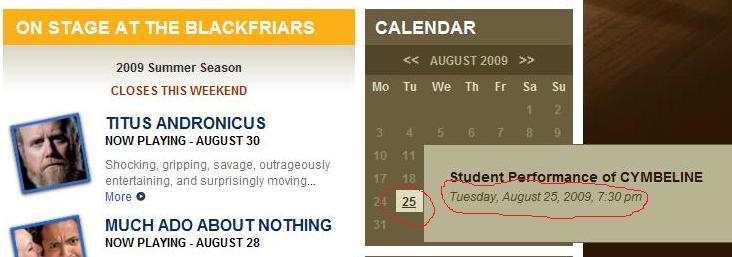
When you have an event scheduled for August 24th, you should probably not have it listed under August 25th on your website:

Clicking the date on the calendar takes one to another page that lists the date as August 25th twice more. It’s a good thing I live a block from the theater, so I didn’t waste much time getting there and back and wondering why the theater was dark and no one was inside. On the other hand, a friend and I did go to the theater twice, returning home in between to check the website and see if I’d read the date wrong, or if the show had been moved or canceled at the last minute. No one was outside, either, the first time, and only two others the second time, so apparently most Blackfriars theatergoers get their news some other way.

Of course, I’m more disappointed by missing the show than annoyed by the relatively minor inconvenience: I’ve never seen Cymbeline. The Texas group’s Antony and Cleopatra last year was quite good. Hmmm . . . was that the problem? Yes, a quick check of my records shows that last year’s show was on August 25th, a Monday. Apparently someone copied last year’s record and failed to adjust the date. I’ll be sure to demand double my money back next time I speak to someone in the ASC management.

Oh, well. Now I can do a better job on the on-line Education courses I’m taking, which have a midnight deadline for submission of three essays. I sent one in last night, but the other two need quite a bit of work, and I can now give them my full attention for an uninterrupted four-hour stretch. I probably shouldn’t say this where one of my instructors might see it, but I’d still rather have seen Cymbeline.

Posted in Blackfriars, Theater Reviews | Leave a comment

And You Thought Roman Numerals Were Unnecessarily Complex . . .

Eugene Volokh quotes M. I. Finley’s warning about the unreliability of numbers in ancient authors:

Even the rare figure to which an ancient author treats us is suspect a priori …. [W]hen Thucydides (7.27.5) tells us that more than 20,000 slaves escaped from Attica in the final decade of the Peloponnesian War, just what do we in fact know? Did Thucydides have a network or agents stationed along the border between Attica and Boeotia for ten years counting the fugitives as they sneaked across? This is not a frivolous question, given the solemnity with which his statement is repeated in modern books and then used as the basis for calculations and conclusions.

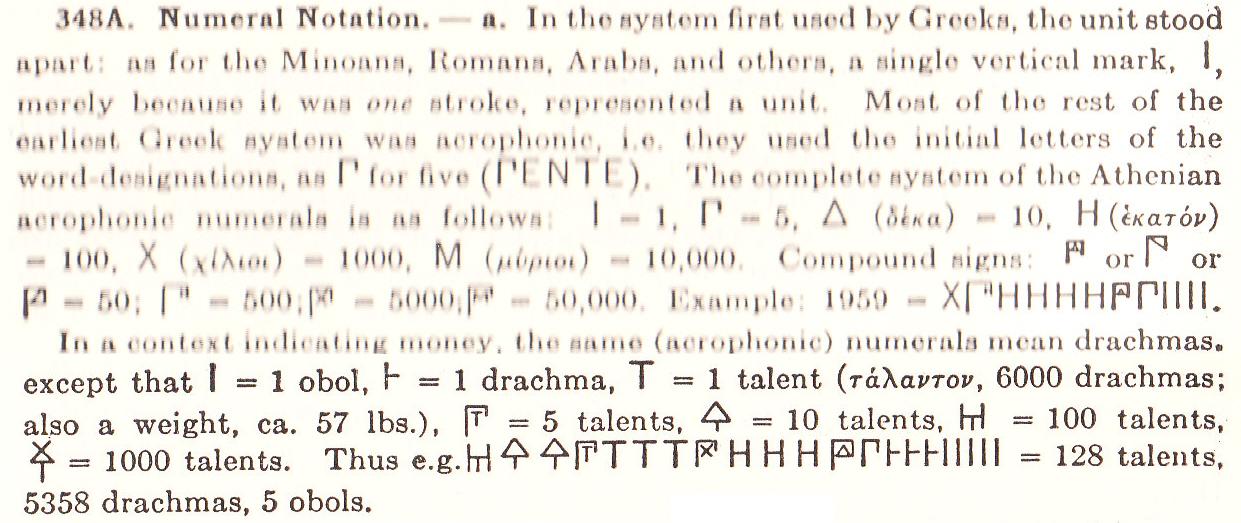
In the comments, Stephen C. Carlson asks “Yikes, how does one know that the figures survived the manuscript transmission by manual copying intact?”. How, indeed? Here’s is just a bit of what H. W. Smyth’s Greek Grammar (revised edition, 1956) has to say about Greek numerical symbols:

Sorry if the top part is illegible: the book is too fat to scan comfortably, so the part from the left-hand page came out very pale and blurry. The problem should be clear, even if the text is not. By the way, I’d never noticed before, but this quotation is from pages 104 and 104A. The rest of the book is numbered normally from i to xviii and then from 1 to 784, but there are extra pages 4A, 4B, 104A, and 104B. (Not that I’ve checked every page, of course: there may be other interruptions to the numerical sequence.) Apparently the 1956 revisions involved inserting some extra pages without resetting the entire work.

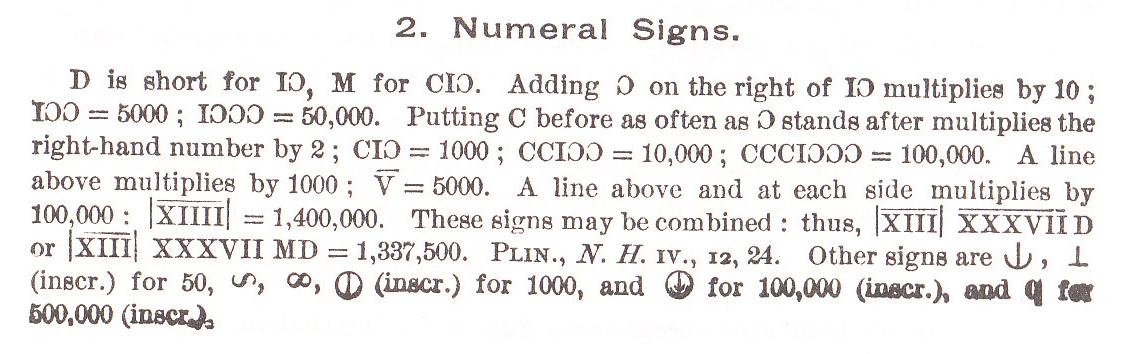
Here is something on Roman numerical symbols, from Gildersleeve and Lodge’s Latin Grammar (3rd edition, 1895, p. 52):

It’s amazing that ancient politicians and businessmen could do their books at all.

Posted in General, Orbilius | Leave a comment

No One Can Escape the Tentacles of the State

I don’t generally waste money on ‘organic’ or ‘natural’ foodstuffs, but when I buy a delicious gooey granola bar from a man wearing a fringe beard, straw hat, white shirt, and suspenders, I really don’t like it to have quite so many inorganic and unnatural ingredients as this:

It makes me wonder whether they’re really ‘home-made’, and whether it’s even legal to sell home-made foodstuffs any more.

Posted in Orbilius | 1 Comment

The Merry Wives of Windsor (ASC vs BBC) I

Like everything else they’ve done, I’ve immensely enjoyed the American Shakespeare Center‘s production of The Merry Wives of Windsor, playing through the end of November, along with Much Ado About Nothing and Titus Andronicus (more about them later). 1 Henry IV will be added to the rotation in early September, George Villier’s The Rehearsal (apparently a cruel parody of Dryden’s tragedies) in October.

I don’t really ‘get’ plays without seeing them more than once, and I’ve seen the ASC Merry Wives four times so far. However, before writing about the production, I thought I’d better look for something to compare it with — something besides their productions of other plays, I mean. I had never seen or read the play before seeing it here, and still haven’t read any scholarship or general essays on it — didn’t want to prejudice my reaction. I have now read it in the Arden edition with most of the notes, watched the 1982 BBC version (the only one available on DVD), and also watched one of the operatic versions, Salieri’s Falstaff (1799), which I had previously seen at Wolftrap and once on DVD, though not recently. (I’ve also seen Verdi’s Falstaff at the Met and on DVD, though not recently, and won’t have much to say about it here.)

Here are my thought so far, for what they are worth:

Text: Both versions had a few cuts. The ASC omits the subplot about the three German horse-thieves (IV.3 and IV.5), along with some of the scholastic humor, though they include the “Castalian king urinal” (II.3), whatever that means (according to Arden, no one knows). The only cuts I noticed in the BBC version were a couple of jokes in the Latin lesson (IV.1) including (oddly) the one that comes across most clearly to a Latinless audience, the one about “the focative case”, which anyone can hear is a dirty joke even if they’ve never heard of the vocative case in Latin or the anatomical meaning of ‘case’ in Elizabethan English.

Humor: In general, the ASC missed fewer opportunities for jokes. There were 3-4 jokes in the BBC version that I hadn’t caught at ASC, mostly in Dr. Caius’ French accent: he calls Anne Page ‘On Podge’and his rival in love ‘Sir Huge’ and when he calls his servant ‘that knave Rog-by’ he pronounces the second word kuh-nave. I assume it is intentional that his repeated “by gar” sounds almost like ‘bugger’. He also asks for his “green pox” (i.e. box), which is more a Welsh than a French accent, though there are other instances of that in the play.

On the other hand, the BBC production missed at least a dozen opportunities that ASC seized. I don’t want to give too many examples, since I hope some of my readers will come to see the play and be as surprised and delighted by them as I was the first time around, but here are two:

  • The look on the face of Mistress Ford (Sarah Fallon) when she reads in Falstaff’s letter (II.1) “You are not young, no more am I” and again when she overhears her husband’s reaction to the news that Falstaff is wooing his wife, saying to Pistol “Why sir, my wife is not young”.
  • When Ford (John Harrell) says “Buck? I would I could wash myself of the buck! Buck, buck, buck! Ay, buck! I warrant you, buck –” (III.1), he kicks the basket hard on each repetition of “buck”. (I hope they arranged some sort of padding for that side of the basket, since Falstaff is in it and barely fits. Perhaps Ford is actually kicking the frame. I’ll have to try sitting on that side of the stage next time I go.)

Sets and Props: The BBC set was of course far fancier, particularly the indoor scenes. I liked the huge timber that bisected Falstaff’s room at waist-height and forced visitors to duck under it. His buck basket was nicer, too, though the clothes in it were far too generic: the ASC’s clothes included a fair percentage of underwear. And Falstaff’s hornèd hat was not obviously made from a football helmet, as at the ASC. On the other hand, Falstaff’s gingham dress was better at the ASC. Of course, these are far from the most important features of a production.

Words: I had trouble hearing all the words in the BBC version. If this were a stage play recorded live, I could blame the technicians, but it was made for TV, so there’s really no excuse. Not that the diction was terrible, but to take one tiny example, I wouldn’t have comprehended Falstaff’s comparison of Pistol and Nym to a “gemini of baboons” (II.2) if I hadn’t already heard the phrase clearly at ASC. When I’m at the Blackfriars, I don’t even notice the actors’ competence in pronouncing and projecting their lines, and reinforcing them with gestures. I just take all that for granted until I see a non-ASC play.

Characters: I’m still gathering my thoughts about the various Pages and Fords. In the mean time, here are some notes on the other characters:

Falstaff: Richard Griffiths (BBC) was a disappointment: too short, too thin, too soft — almost effeminate, and way too young. He looked 25, and I was surprised to learn from IMDB that he was 35 when the film was made. Nolan Carey (ASC’s Nym) played Falstaff in the MFA production of 2 Henry IV earlier this year, and also looked too young, but there’s only so much you can do with makeup, and youthful looks are to be expected in a student production. He was tall enough and fat enough for the part, though his fat suit got a little carried away in the (how shall I put this?) man-boobs area. James Keegan’s ASC Falstaff is, or appears to be, taller, fatter, older, and at the same time more vigorous than Griffiths, and he wears his fat suit very naturally. He is, in short, imposing. I’ve only dipped into my two recordings of Verdi’s opera lately (Haitink at the Royal Opera House in 1999, with Bryn Terfel in the title role, and Muti at La Scala in 2001), but all three of the operatic Falstaffs I’ve seen have the appropriate height, heft, and general vigor and dominance. Muti’s Falstaff, Ambrogio Maestri, ruins this with a hair style blatantly lifted from Krusty the Clown, but that’s another story.

Bardolph, Pistol, Nym, and Mine Host of the Garter: With no doubling of roles and (presumably) a much larger budget, the BBC does a good job with these four. I found it hard to understand the stylistic jokes in both versions (Pistol’s Marlovian boasting, Nym’s “humors”) and had to read about them in the Arden edition, but I suppose that is inevitable.

Shallow: Alan Bennett (BBC) is a harmless and very decrepit old man, while René Thornton, Jr. (ASC) is a hilariously dirty old perv, though he is too big and healthy to look quite as decrepit as he ought.

Slender: Richard O’Callaghan (BBC) is depicted as a fop, in fact looks a bit like some depictions of Shakespeare, and his “I am not altogether an ass” is fairly convincing. The ASC Slender (Chris Johnston) is altogether an ass and then some, and comes across as very young and a total dork — hilariously awful.

Fenton: Not much to say except that Tobias Shaw (ASC) is younger and much handsomer than his BBC counterpart.

Sir Hugh Evans: The BBC Sir Hugh’s Welsh accent, though presumably authentic, was nearly undetectable, at least to my untutored ears. Apparently the BBC thought putting a real Welshman in the part (Tenniel Evans) would suffice, but his failure to audibly mix up his Bs and Ps and so on ruined many of the jokes. Perhaps they were afraid of offending the Welsh, but a fake Welshman with a comically-exaggerated accent, like Chris Seiler at the ASC, would have been funnier. (Cf. Henry James, “The Real Thing”.)

Dr Caius: Daniel Rigney (ASC) looks much younger than Michael Bryant (BBC) and also (therefore?) less threatening, both to his servants and to Sir Hugh. I’m not sure whether that’s a plus or a minus or just a difference. I’m also not sure whether making Dr Caius and Slender look twice the age of Anne Page is a good thing in so far as May-December matches are both historically plausible and creepy, or whether that distracts from the main lines of the plot. Still thinking about this.

Mistress Quickly: Without giving away too many details for those who haven’t seen the play, Alison Glenzer (ASC) makes very effective use of her skirt and cleavage for comic purposes. The BBC Quickly was rather dull, at least by comparison.

Bit Parts: I don’t have much to say about the servants except that I couldn’t tell whether Ron Cook’s Peter Simple (BBC) was supposed to be 15 or 40 — he always seemed to be one or the other, nothing in between, which was a bit disturbing, and his simpleness looked like cliché mental retardation, while Erin Baird (ASC) comes across as none too swift but mostly naïve and very young.

The BBC postmaster’s boy and the other male ‘bride’ at the end were played by actual boys who could plausibly pass for girls. At least I’m assuming they were boys: it wasn’t easy to tell, which I suppose was the point. More farcically, the ASC uses the two biggest available men in the cast, René Thornton, Jr. and Nolan Carey. In this case, as in most cases, I prefer farce to verisimilitude.

How to sum up? If you’re anywhere near Staunton, Virginia, come see the play.
Posted in Blackfriars, Culture: Plays, Theater Reviews | Leave a comment

The Merry Wives of Windsor (ASC vs BBC) I

Like everything else they’ve done, I’ve immensely enjoyed the American Shakespeare Center‘s production of The Merry Wives of Windsor, playing through the end of November, along with Much Ado About Nothing and Titus Andronicus (more about them later). 1 Henry IV will be added to the rotation in early September, George Villier’s The Rehearsal (apparently a cruel parody of Dryden’s tragedies) in October.

I don’t really ‘get’ plays without seeing them more than once, and I’ve seen the ASC Merry Wives four times so far. However, before writing about the production, I thought I’d better look for something to compare it with — something besides their productions of other plays, I mean. I had never seen or read the play before seeing it here, and still haven’t read any scholarship or general essays on it — didn’t want to prejudice my reaction. I have now read it in the Arden edition with most of the notes, watched the 1982 BBC version (the only one available on DVD), and also watched one of the operatic versions, Salieri’s Falstaff (1799), which I had previously seen at Wolftrap and once on DVD, though not recently. (I’ve also seen Verdi’s Falstaff at the Met and on DVD, though not recently, and won’t have much to say about it here.)

Here are my thought so far, for what they are worth:

Text: Both versions had a few cuts. The ASC omits the subplot about the three German horse-thieves (IV.3 and IV.5), along with some of the scholastic humor, though they include the “Castalian king urinal” (II.3), whatever that means (according to Arden, no one knows). The only cuts I noticed in the BBC version were a couple of jokes in the Latin lesson (IV.1) including (oddly) the one that comes across most clearly to a Latinless audience, the one about “the focative case”, which anyone can hear is a dirty joke even if they’ve never heard of the vocative case in Latin or the anatomical meaning of ‘case’ in Elizabethan English.

Humor: In general, the ASC missed fewer opportunities for jokes. There were 3-4 jokes in the BBC version that I hadn’t caught at ASC, mostly in Dr. Caius’ French accent: he calls Anne Page ‘On Podge’and his rival in love ‘Sir Huge’ and when he calls his servant ‘that knave Rog-by’ he pronounces the second word kuh-nave. I assume it is intentional that his repeated “by gar” sounds almost like ‘bugger’. He also asks for his “green pox” (i.e. box), which is more a Welsh than a French accent, though there are other instances of that in the play.

On the other hand, the BBC production missed at least a dozen opportunities that ASC seized. I don’t want to give too many examples, since I hope some of my readers will come to see the play and be as surprised and delighted by them as I was the first time around, but here are two:

  • The look on the face of Mistress Ford (Sarah Fallon) when she reads in Falstaff’s letter (II.1) “You are not young, no more am I” and again when she overhears her husband’s reaction to the news that Falstaff is wooing his wife, saying to Pistol “Why sir, my wife is not young”.
  • When Ford (John Harrell) says “Buck? I would I could wash myself of the buck! Buck, buck, buck! Ay, buck! I warrant you, buck –” (III.1), he kicks the basket hard on each repetition of “buck”. (I hope they arranged some sort of padding for that side of the basket, since Falstaff is in it and barely fits. Perhaps Ford is actually kicking the frame. I’ll have to try sitting on that side of the stage next time I go.)

Sets and Props: The BBC set was of course far fancier, particularly the indoor scenes. I liked the huge timber that bisected Falstaff’s room at waist-height and forced visitors to duck under it. His buck basket was nicer, too, though the clothes in it were far too generic: the ASC’s clothes included a fair percentage of underwear. And Falstaff’s hornèd hat was not obviously made from a football helmet, as at the ASC. On the other hand, Falstaff’s gingham dress was better at the ASC. Of course, these are far from the most important features of a production.

Words: I had trouble hearing all the words in the BBC version. If this were a stage play recorded live, I could blame the technicians, but it was made for TV, so there’s really no excuse. Not that the diction was terrible, but to take one tiny example, I wouldn’t have comprehended Falstaff’s comparison of Pistol and Nym to a “gemini of baboons” (II.2) if I hadn’t already heard the phrase clearly at ASC. When I’m at the Blackfriars, I don’t even notice the actors’ competence in pronouncing and projecting their lines, and reinforcing them with gestures. I just take all that for granted until I see a non-ASC play.

Characters: I’m still gathering my thoughts about the various Pages and Fords. In the mean time, here are some notes on the other characters:

Falstaff: Richard Griffiths (BBC) was a disappointment: too short, too thin, too soft — almost effeminate, and way too young. He looked 25, and I was surprised to learn from IMDB that he was 35 when the film was made. Nolan Carey (ASC’s Nym) played Falstaff in the MFA production of 2 Henry IV earlier this year, and also looked too young, but there’s only so much you can do with makeup, and youthful looks are to be expected in a student production. He was tall enough and fat enough for the part, though his fat suit got a little carried away in the (how shall I put this?) man-boobs area. James Keegan’s ASC Falstaff is, or appears to be, taller, fatter, older, and at the same time more vigorous than Griffiths, and he wears his fat suit very naturally. He is, in short, imposing. I’ve only dipped into my two recordings of Verdi’s opera lately (Haitink at the Royal Opera House in 1999, with Bryn Terfel in the title role, and Muti at La Scala in 2001), but all three of the operatic Falstaffs I’ve seen have the appropriate height, heft, and general vigor and dominance. Muti’s Falstaff, Ambrogio Maestri, ruins this with a hair style blatantly lifted from Krusty the Clown, but that’s another story.

Bardolph, Pistol, Nym, and Mine Host of the Garter: With no doubling of roles and (presumably) a much larger budget, the BBC does a good job with these four. I found it hard to understand the stylistic jokes in both versions (Pistol’s Marlovian boasting, Nym’s “humors”) and had to read about them in the Arden edition, but I suppose that is inevitable.

Shallow: Alan Bennett (BBC) is a harmless and very decrepit old man, while René Thornton, Jr. (ASC) is a hilariously dirty old perv, though he is too big and healthy to look quite as decrepit as he ought.

Slender: Richard O’Callaghan (BBC) is depicted as a fop, in fact looks a bit like some depictions of Shakespeare, and his “I am not altogether an ass” is fairly convincing. The ASC Slender (Chris Johnston) is altogether an ass and then some, and comes across as very young and a total dork — hilariously awful.

Fenton: Not much to say except that Tobias Shaw (ASC) is younger and much handsomer than his BBC counterpart.

Sir Hugh Evans: The BBC Sir Hugh’s Welsh accent, though presumably authentic, was nearly undetectable, at least to my untutored ears. Apparently the BBC thought putting a real Welshman in the part (Tenniel Evans) would suffice, but his failure to audibly mix up his Bs and Ps and so on ruined many of the jokes. Perhaps they were afraid of offending the Welsh, but a fake Welshman with a comically-exaggerated accent, like Chris Seiler at the ASC, would have been funnier. (Cf. Henry James, “The Real Thing”.)

Dr Caius: Daniel Rigney (ASC) looks much younger than Michael Bryant (BBC) and also (therefore?) less threatening, both to his servants and to Sir Hugh. I’m not sure whether that’s a plus or a minus or just a difference. I’m also not sure whether making Dr Caius and Slender look twice the age of Anne Page is a good thing in so far as May-December matches are both historically plausible and creepy, or whether that distracts from the main lines of the plot. Still thinking about this.

Mistress Quickly: Without giving away too many details for those who haven’t seen the play, Alison Glenzer (ASC) makes very effective use of her skirt and cleavage for comic purposes. The BBC Quickly was rather dull, at least by comparison.

Bit Parts: I don’t have much to say about the servants except that I couldn’t tell whether Ron Cook’s Peter Simple (BBC) was supposed to be 15 or 40 — he always seemed to be one or the other, nothing in between, which was a bit disturbing, and his simpleness looked like cliché mental retardation, while Erin Baird (ASC) comes across as none too swift but mostly naïve and very young.

The BBC postmaster’s boy and the other male ‘bride’ at the end were played by actual boys who could plausibly pass for girls. At least I’m assuming they were boys: it wasn’t easy to tell, which I suppose was the point. More farcically, the ASC uses the two biggest available men in the cast, René Thornton, Jr. and Nolan Carey. In this case, as in most cases, I prefer farce to verisimilitude.

How to sum up? If you’re anywhere near Staunton, Virginia, come see the play.

Posted in Blackfriars, Culture: Plays, Theater Reviews | Leave a comment

Shakespeare at the Blackfriars Theatre in Staunton

I moved to Staunton, Virginia a year ago last week for a number of reasons, but primarily so I could go to plays at the Blackfriars Playhouse. I’d been driving 4 1/2 hours each way from Raleigh every few months to see three shows in a weekend, so when a good Latin-teaching job in a neighboring county was advertised, I jumped at the chance to live a block and a half from the theater and go whenever I like. In my first year in town, I saw 105 performances of 17 different plays, or roughly two per week, not counting unstaged readings and MFA productions. (The Master of Fine Arts in Shakespeare Studies program at Mary Baldwin College is closely associated with the American Shakespeare Center, and the MFA students put on several shows per year at the Blackfriars. I went to all four shows of their As You Like It: it was that good.) It’s time I started posting about what I have seen.

My qualifications for theatrical reviewing are questionable: over the years I’ve read a lot of plays, mostly ancient, seen only a few until I moved here, and acted in none. I’ve also read very little, theoretical or practical, about post-classical drama. However, I won’t let that stop me. First up: Merry Wives of Windsor, later today.

Please note: If you are only interested in reading my reviews of Blackfriars productions, use this link. If you are interested in reading all of my theater reviews, use this link.

Posted in Blackfriars, Culture: Plays, Theater Reviews | Leave a comment

Good News, I Guess

It would take 10 shots of Absinthe to kill me

Created by Bar StoolsCold Fury)

Posted in General | Leave a comment