Pictolanche

In checking my blog statistics yesterday, I found that I had gotten well over 100 hits from a link in The Scotsman last Monday. The author complains that the newspaper’s porn filters think that my Latin text of Juvenal’s 10th Satire counts as “nudity”. The article goes on to quote some mildly titillating classical bits available on the web that were not caught by the inept filter. I still don’t understand why a newspaper’s editorial offices would need such a filter at all. Surely the inhabitants are all adults?

Posted in Latin Literature | Tagged | Leave a comment

More On Statius’ Somnus

The most recent (though not very recent) post on Gabriel Laguna’s Tradición Clásica is on Statius, Silvae 5.4, the ‘Ode to Sleep’. One of first things I put on the web here was ‘Sonnets to Morpheus’, with texts of Statius’ poem and three elaborate Renaissance imitations, by Jacob Balde and Janus Pannonius in Latin and Francisco de Quevedo y Villegas in Castilian Spanish. (None of them are sonnets: I just like puns.) It’s interesting that all three chose the shortest and (by common consent) best of Statius’ Silvae and then expanded it to lengths more typical of the rest of the Silvae.

I have now fixed the link, which was broken, and changed the background to a less intrusive pattern. One of these days I hope to add an apparatus to the Statius, plus a couple of more poems on the same theme whose authors and titles I have jotted down somewhere in my chaotic files.

Posted in Latin Literature | Tagged , | Leave a comment

New Feature

That would be the PayPal button at the bottom of the left column.

My laptop suddenly went catatonic on Tuesday, leaving me with no computer except my 8 1/2 year old Pentium II desktop. Until today, I wasn’t even able to edit my websites, since I’d misplaced the WordPress passwords. They are now safely written down on a slip of paper tucked into a certain page of a book no one else would ever think to look in. Pocock’s translation of Statius’ Thebaid into Spenserian stanzas? No, that’s actually an interesting work both in theory and in small doses and might attract attention, plus I don’t own a copy. The edition of ‘Sext Properci’ by Balcells and Minguez with facing Catalan translation? That might well intrigue a Barcelonés, a Romance philologist, or a Propertian. Ciani’s Lexicon zu Lycophron? That would probably work, except that its presence on my desk in easy reach of the keyboard would itself attract suspicion. (Yes, I have a copy. No, I don’t know why I bought it. Yes, it must have been on sale. No, I’ve never opened it. Yes, I expect to do so once or twice before I die, probably a lot more than once or twice, once I get around to reading Lycophron. Satisfied?)

This has the makings of an interesting game:

What classical work, primary or secondary, would be least likely to attract the notice of an average cross-section of classicists and others browsing my shelves or yours? Suggestions may be placed in the comments. The question is not which is actually the most boring — that could cause unpleasantness if the author is still alive — but which has the least attractive title and subject. Narrowness of appeal would count for a great deal. The Manuscript Tradition of Cornelius Nepos? There are narrower and far more tedious titles than that.

To return to my computer problems . . . .

Fortunately, I have twelve more days until the laptop warranty expires. Unfortunately, the problem seems to be in the hard drive, and it contains a lot of files I can’t easily do without. I’m hoping to be able to hire someone this week to try to copy the data off it before I send the machine to HP for repair. Since money is very tight at the moment, I will be extremely grateful for any contributions (hence the PayPal button), as well as any suggestions for what I can do technically.

Since I’m in the ‘bargaining’ stage of my electronic grief, I can also promise more and better posts now that I have regained access. I’ve had plenty to say, with little time to say it, but two weeks off for Christmas solves that problem, at least for the moment.

Posted in General | Leave a comment

Quotation Of The Day: Ben Jonson

Vulgi expectatio

Expectation of the Vulgar is more drawne, and held with newnesse, then goodnesse; wee see it in Fencers, in Players, in Poets, in Preachers, in all, where Fame promiseth any thing; so it be new, though never so naught, and depraved, they run to it, and are taken.

(Timber, or Discoveries, Oxford edition, Volume VIII, 576)

Posted in Culture: Poetry | Leave a comment

Horace In Rossini

In honor of the 2012th anniversary of the death of Horace, here is the opening of Act I, Scene XIV of Rossini’s delightful Il Turco in Italia, which I saw and heard for the first time today (on DVD). The speaker is the poet Prosdocimo, who constantly interferes in the action in a proto-pomo way:

Ho quasi del mio dramma
Finito l’orditura;
Ma un atto è poco a un dramma,
E Orazio dice che minore
Di cinque esser non può.
Ma in due parti dividerlo io dovrò,
Che gli uditori miei
Sarian ben presto, caro Orazio, stufi
Se fosser di cinque atti i drammi bufi.

I’ve almost finished
the plot of my play;
but one act is too little for a stage piece,
and Horace says that it cannot consist
of less than five.
But I’ll have to divide it into two parts,
otherwise, dear Horace,
my listeners would soon be irked
if comedies were written in five acts.

Text and translation are quoted from the liner notes to the 1998 La Scala recording conducted by Ricardo Chailly and sung by Cecilia Bartoli, Alessandro Corbelli, Michele Pertusi, and Ramón Vargas (London 289 458 924-2). Yes, I bought the CD and the DVD before listening to either: I’ve seen and heard enough Rossini to know I was unlikely to be disappointed.

I still have trouble seeing Horace as an authority on dramaturgy. In this case, Rossini seems to have the better of the argument. I watched the DVD of Salieri’s five-act Tarare a few weeks ago. Despite an amusing plot and a libretto by Beaumarchais, I found it rather a bore. On the other hand, Salieri’s two-act Falstaff, which I saw at Wolftrap a year or two ago, was quite diverting.

I suppose the most suitable memorial reading for Horace would be Carmina 3.30.

Posted in Latin Literature, Nachleben, Opera | Tagged | 1 Comment

Good Advice?

No debemos utilizar como documento histórico las obras maestras, sino las mediocres.
Lo que diferencia a las épocas es su manera de fracasar.

For historical evidence, we should not use the masterpieces but the mediocre works.
What distinguishes epochs is their style of failure.

(Nicolás Gómez Dávila, Escolios a un Texto Implícito, 1.372)

Posted in - Aphorisms, Ephemerides | Leave a comment

Gómez Dávila On Reading

Sólo debemos leer para descubrir lo que debemos releer eternamente.

We ought to read only to discover what we ought to reread forever.

(Nicolás Gómez Dávila, Escolios a un Texto Implícito, 1.214)

Lector auténtico es el que lee por placer los libros que los demás sólo estudian.

The true reader is the one who reads for pleasure the books that the rest only study.

(2.486)

Posted in - Aphorisms, Ephemerides | Leave a comment

Pedantic Leg Footnote

If I’m not mistaken, the “gloriously accoutred warrior”* Chloreus who inadvertently lures Camilla to her death in Book XI is the first character in the Aeneid who is wearing any pants: of his many colorful garments, the last mentioned is barbara tegmina crurum (11.777). He is probably the last, too, though I have another book to go in my current (re)reading of the Aeneid. A peek in the OCT index tells me that Chloreus is killed off in 12.363, where he shares a single line with two nonentities, Sybaris and Thersilochus, along with Dares, presumably the loser of the boxing-match in Book V. At least he and Dares get single-word death-notices, if not full-scale obituaries: in the Iliad, Nireus, the handsomest of all the Greeks at Troy after Achilles, is never mentioned after his five lines in the Catalogue of Ships (2.671-75).

– – – – – – – – – – – – – – – – –

*The description is from R. D. Williams, ad loc.

Posted in Latin Literature | Tagged | Leave a comment

Gómez Dávila on Caesar

La prosa de César es la voz misma del patriciado: dura, sencilla, lúcida.
La aristocracia no es un montón de oropeles, sino una voz tajante.

Caesar’s prose is the very voice of the patriciate: hard, simple, transparent.
The aristocracy is not a pile of gold tinsel, but a distinct voice.

(Nicolás Gómez Dávila, Escolios a un Texto Implícito, 2.481)

Posted in - Aphorisms, Ephemerides, Latin Literature | Tagged | Leave a comment

More Books

I’ve added a dozen or so titles (all in Classics) to my list of Books for Sale (link in the left margin). Several seem to be rarities — at least no one else is offering copies on ABE. Please take them off my hands so I can buy more.

Posted in Announcements | Leave a comment

Aphorism Of The Day

Hoy para ser puritano basta tener gusto.

To be a puritan today, it is enough to have taste.

(Nicolás Gómez Dávila, Escolios a un Texto Implícito, 1.379)

Posted in - Aphorisms, Ephemerides | Leave a comment

Words I’d Like To See In A Dedication

I would like to thank my colleagues in the Department of X at the University of Y for helping me complete this book. But they didn’t, so I can’t.

Please note: when I call these “words I’d like to see”, I don’t mean to imply that they haven’t been written already by some disgruntled academic somewhere, just that I haven’t seen them.

Posted in General | Leave a comment

Ancient Shock Therapy?

Laudator Temporis Acti joins Rogue Classicism in wondering “whether there is any truth to the claim that the ancient Romans treated brain disorders or headaches with electric eels”. LTA also asks whether the electric ray or electric catfish (pictured below) might be more likely, since electric eels are found only in the Western Hemisphere, while RC is very doubtful that any ancient source can be found.

In fact, there is one. In his Compositiones, Scribonius Largus describes the use of the torpedo to treat headaches:

Capitis dolorem quamvis veterem et intolerabilem protinus tollit et in perpetuum remediat torpedo nigra viva inposita eo loco, qui in dolore est, donec desinat dolor et obstupescat ea pars. Quod cum primum senserit, removeatur remedium, ne sensus auferatur eius partis. Plures autem parandae sunt eius generis torpedines, quia nonnumquam vix ad duas tresve respondet curatio, id est torpor, quod signum est remediationis.

A rough translation:

To immediately remove and permanently cure a headache, however long-lasting and intolerable, a live black torpedo is put on the place which is in pain, until the pain ceases and the part grows numb. When it first has felt it [= numbness?], let the cure be removed, so that that part’s feeling may not be destroyed. Several torpedos of this kind should be prepared, since sometimes the treatment, i.e. the numbness which is the sign of healing, hardly responds to two or three.

The text is quoted from G. Helmreich’s 1887 Teubner edition of Scribonius, via David Camden’s Forum Romanum / Corpus Scriptorum Latinorum site. This is chapter 11. Chapter 162, also mentioned in the OLD s.v. torpedo, is not on-line, though indexed. A headache that can be localized to one particular part of the head must be a migraine. Then again, I wonder if severe depression would count as a dolor of the head.

Whether Scribonius’ torpedo is an electric ray or an electric catfish is unclear. Of the latter, D’Arcy Thompson writes (Glossary of Greek Fishes, Oxford, 1947, 172):

The medical value of its shock is recognized by native tribes in Africa, and was known to the Arabian physicians in early times. As the marine Torpedo would be awkward to manage and difficult to keep alive, one may imagine that Pliny was referring, in part at least, to the Egyptian fish.

So far as I can see, Thompson does not refer to Scribonius, and does not quote any passage of Pliny clearly referring to shock treatments with live fish, though he does allege that the liver was an antaphrodisiac, among other improbabilities. Perhaps something went wrong with his notes, and he meant to write “Scribonius” for “Pliny” in the passage quoted.

The catfish picture is borrowed from the Forth Worth Zoo site, copied here to avoid bandwidth theft and link rot. The very human fat pink lips are a disturbingly creepy touch, worthy of a horror movie. To add to the horror, Thompson reports that they grow up to three feet long.
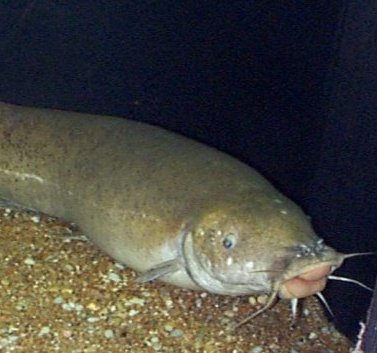
Creepy Electric Catfish

Posted in Latin Literature | 1 Comment

Reading Notes: Trollope

From Chapter I of Anthony Trollope’s Dr. Wortle’s School, I learn that British schools provided their pupils (aged 11-17) with beer every day, and with wine and even champagne when they were ill. In Chapter III, a boy who falls in the river is given sherry negus, a mixture of sherry and hot water with sugar, lemon juice, and nutmeg. Mmmmm. The definition is from the annotator of the Penguin edition. (I almost wrote “translation” for edition, which shows how little English literature I read. Or perhaps having notes in the back makes it look like one.) Not a bad novel, though I would have liked to read more about what went on in the classroom. The one bit that is given (Chapter VIII) is interesting:

‘Clifford, junior,’ he said, ‘I shall never make you understand what Cæsar says here or elsewhere if you do not give your entire mind to Cæsar.’

‘I do give my entire mind to Cæsar,’ said Clifford, junior.

‘Very well; now go on and try again. But remember that Caesar wants all your mind.’

I find the ae ligatures (æ) in ‘Cæsar’ mildly annoying: though unobjectionable in ‘hæmatology’ and ‘ætiology’, they seem out of place in a proper name.

Posted in Culture: Fiction, Latin Literature, Teaching | Tagged | Leave a comment

Ludus Elegiacus

In 1937, a Latin teacher named L. E. Eyres published his “Ludus Elegiacus” in Greece & Rome (pages 56-57 and 155). It is a set of twenty-five epigrams in elegiac couplets, the first five of four lines each, the rest single couplets. As the editor’s introduction states, it was designed “to teach a School Certificate class to recognize the difference in meaning between words of similar appearance, and to use scansion as an aid to translation”. Because of copyright laws, I can’t reproduce the whole thing, but here are a few samples:

6. The street-singer and his dog.

Cane, canet canis hic: solus cantare recusat:
   Deest mihi vox: tu, sis, cum cane, cane, cane.

9. Ship’s rations.

Navigat ad Cares coniunx meus: esurit ergo:
   Quod tam cara caro, carne carina caret.

17. The scrounger.

Anulus annosae fuerat; mihi saepe precato
   Annuit: insipiens est anus, anne sapit?

Of course, this last omits one of the Latin words beginning with an- as inappropriate for schoolboys. No such inhibition was felt by Colin Haycroft of Duckworth & Co. in a letter published in the (London) Spectator on July 20, 1985:

Sir: As the subject of ‘mooning’ at Greenham Common has raised its ugly head (?) in your columns (Home life, 13 July), may I submit to you an epigram (veiled in the decent obscurity of a learned language) inspired by a recent incident that occasioned a lady’s protest?

Terga tuens duri versa ad se militis olim,
   ‘ei mihi, nil gratum est’ dixerat ‘anus’ anus.

Posted in Latin Grammar, Work: Teaching | Tagged | Leave a comment

Tell Me Something I Don’t Already Know

Posted in General | Leave a comment

What I’ve Been Reading

Anthony Grafton’s The Footnote: A Curious History (1997). Here’s my favorite passage so far (62-63):

Around the turn of the century, many American universities began to make themselves over, following what they saw as the German model. Professors, many of whom had enjoyed the adventure of studying in scholarly Göttingen, romantic Heidelberg, or metropolitan Berlin, began to enroll graduate students and offer specialized seminars at home. They carved out new spaces for these advanced courses–often within the impressively crenelated university libraries of the time, in rooms equipped with reference books and primary sources. Students from Berkeley to Baltimore could learn dead languages, master bibliographies, and apply sophisticated research techniques, just as their teachers had. And they could do so without having to live in Germany, drink beer, and translate texts, extemporaneously, into as well as out of Gothic and Anglo-Saxon, as German professors required the members of seminars to do.

Posted in General | Leave a comment

Semi-New Feature

I have added a category in the left column for ‘Lists of Commentaries’. So far, the only one is for Seneca’s Epistulae Morales, though Ovid’s Heroides will follow. This is not a complete bibliography, but a cross-reference of letters against commentators. I made it for my own use, since it is so hard to keep track of who comments on which letter, and post it now since others may find it useful. Similar lists would be very helpful for (e.g.) Pindar: if anyone has one I would be glad to link it or host it.

I have previously posted a one-page PDF version of the Seneca list, and that will be updated soon to reflect the latest information: I only recently learned of the commentaries on Epistles 22 and 23 by Laudizi and 93 and 99 by Op het Veld.

The list is not just a practical tool. It is interesting to see which letters have attracted multiple commentaries, and which (about a third) have attracted none. Editors have their own prejudices: for instance, Motto’s school commentary has a strong preference for the shortest letters, while Summers has a strong preference for those in the range 76-90, commenting on no fewer than 10 1/2 of the 15. If I have missed any, I hope someone will let me know.

Posted in Bibliographies, Latin Literature | Tagged | Leave a comment

Never Send A Machine To Do A Man’s Job

James Lileks finds some coded Latin on a website, but concludes that it must be gibberish, since the online Latin translator couldn’t handle it. That just shows how stupid machines are. It’s not quite classical Latin, but close enough to translate. Lileks’ text is also missing the first letter — easy enough when it’s written in Morse code and the letter is an I. It should read:

IN GIRUM IMUS NOCTE ET CONSUMIMUR IGNI.

Classical Latin would spell the second word GYRUM and the last one IGNE, but this is good Mediaeval (aka Vulgar) Latin. It means “At night we go into a gyre/whirl/circle/ring and are consumed by fire”. That’s not a very clear or satisfying meaning, but better than average for palindromes. With one more syllable at the beginning, it would be a dactylic hexameter: again, that’s probably the best meter we can expect from a palindrome. The version with ECCE (“look!”) inserted after NOCTE fulfills (barely) the minimum requirements for a hexameter, but the meaning is even clunkier.

This site has some interesting, but not entirely accurate, information on the words (click on Palindromes – it’s the first one on the right), plus much more of interest to Latinists. I don’t see anything macaronic about the line, and suspect that a moth would be at least as likely as a mayfly to fly in circles and be consumed by fire. I wonder if this gyre has anything to do with the one Yeats asked someone or other to perne in in “Sailing to Byzantium”.

Posted in Culture: Poetry, Orbilius | 1 Comment

What Did Seneca Know About Babies?

Not much, to judge by E. M. 22.15, where Natura addresses those dying old:

‘Sine cupiditatibus uos genui, sine timoribus, sine superstitione, sine perfidia ceterisque pestibus; quales intrastis exite.’

“I engendered you without desires, without fears, without superstition, without treachery and the other curses; go out as you were when you came in.”

Very eloquent, but since when are babies born sine cupiditatibus? They have very little else in mind except a few basic desires: to be fed, held, kept clean and warm, and allowed to sleep, all with very little notice and the expectation of immediate obedience. What was Seneca thinking when he wrote this?

I’ve been leafing through the Epistulae Morales, rereading the two dozen or so I’ve read before and dipping into others. Time to read them through? Perhaps not: there are an awful lot of them.

Posted in Latin Literature | Tagged | 2 Comments