Hmmmmm . . . .

Terry Teachout’s life of H. L. Mencken is titled The Skeptic. Given Mencken’s taste (and aptitude) for invective, it might just as easily have been titled The Skoptic — not that anyone outside of Classics departments would know what that means.

Posted in Orbilius | Leave a comment

Quotation of the Millennium

The juvenile sea squirt wanders through the sea searching for a suitable rock or hunk of coral to cling to and make its home for life. For this task, it has a rudimentary nervous system. When it finds its spot and takes root, it doesn’t need its brain anymore so it eats it! (It’s rather like getting tenure.)

(Daniel Dennett, Consciousness Explained, 177)

Posted in - Quotations, Ephemerides, Work: Teaching | 1 Comment

A Missed Opportunity

The BBC reports the discovery (or reclassification) of a huge underwater volcano off the south coast of Sicily, which scientists have named Empedocles. They explain the name in their last paragraph:

The volcano was named Empedocles after the Greek philosopher who hypothesised that all matter consisted of four elements – earth, air, fire and water.

This is inadequate. They ought to have mentioned that Empedocles was from Acragas (now Agrigento), on the south coast of Italy, though further east than his eponymous volcano. He was a local boy, and that surely influenced the naming of the volcano. They ought also to have mentioned that Empedocles had a closer connection to volcanos than any other ancient writer, even the Elder Pliny, since he was said to have died by throwing himself into the crater of Mount Etna. The legend was once so well-known that Matthew Arnold could title a poem about a dying woman “Empedocles on Etna” with no further explanation (text here). Other notable bits of nachleben are Hölderlin’s play Der Tod des Empedokles (I haven’t read it, but assume a volcano is involved), the postscript to the suicide note of Ryonosuke Akutagawa (author of Rashomon), and the last page of Horace’s Ars Poetica (463-66):

                                        Siculique poetae
narrabo interitum. deus immortalis haberi
dum cupit Empedocles, ardentem frigidus Aetnam
insiluit.

I will tell you the end of the Sicilian poet. Empedocles, eager to be thought an immortal god, coldly leapt into burning Etna.

In researching this post, I ran across Peitho’s Web, which includes a Greek text of the fragments of Empedocles, interleaved with Leonard’s 1898 translation.

Posted in General | Leave a comment

Two (Non-Classical) Riddles

What fact connects the following words?

cross, lane, return, rock, waltz

How about the following series of words and phrases?

amnesia, babe, baby, blues, crowd, gal, girls, hardwood floor, healin’, heart, husband, man, merry go round, moon, night time man, season, song, troubles, waltz, women

Too hard? If suffixes count, the second series also includes -in’ and -itis. And the two riddles are parallel: they have different answers, but work in much the same way. Answers may be placed in the comments. There is no prize but the honor of solving the puzzle. There may be another clue around here somewhere, too.

Posted in Music, Orbilius | 4 Comments

Scholastic Humor

In Martial: Select Epigrams (Cambridge ‘green and gold’, 2003), Lindsay and Patricia Watson include 4.87 (71 in their numeration):

Infantem secum semper tua Bassa, Fabulle,
    conlocat et lusus deliciasque uocat,
et, quo mireris magis, infantaria non est.
    ergo quid in causa est? pedere Bassa solet.

For a text with apparatus, go here and scroll down to the third-to-last epigram. The Watsons’ paraphrase:

Your acquaintance Bassa, Fabullus, is forever cuddling a baby and calling it her darling. The odd thing is that she is not baby-minded. The reason? She is given to farting.

The scholastic humor is in the notes, where the Watsons write “the topic receives an airing in other comic writers” and “[t]he inveterate farter is a butt of comedy”.

Posted in Exegesis, Latin Literature | Tagged | 1 Comment

An Editorial Shipwreck

I’ve been reading the new translation of Sebastiano Timpanaro’s The Genesis of Lachmann’s Method, edited and translated by Glenn W. Most and published by the University of Chicago Press (2005). Or rather, I have been trying to read it, but something seems to have gone terribly wrong with the editing. Here are a few quotations from the translator’s preface:

Under [Pasquali’s and Fraenkel’s] guidance Timpanaro laid the scholarly foundations for his later work on Classical literature, especially on Latin poetry (above all in the highly technical disciplines of textual criticism and of microexegetical and lexical studies) and on the history of scholarship on Latin poetry during antiquity. In both these fields, Timpanaro made numerous significant and lasting contributions (collected in Timpanaro 1978, 1986, 1994a, and 2001a), though he always preferred the form of the small, astonishingly erudite, highly condensed philological note to that of the expansive literary monograph and though he never himself undertook the full-scale editions of such authors as Ennius and Virgil that his teachers had hoped he would do. (3)

. . . a study of Giacomo Leopardi’s contributions to Classical studies (Timpanaro 1955, 1977a, 1997a): . . . (4)

. . . a number of other studies . . . mostly devoted to nineteenth-century Italian writers (collected in Timpanaro 1965, 1969, 1980a, 1982, 1984a, 1994b). (4)

. . . a collection of essays titled On Materialism (Timpanaro 1970, 1975a, 1997b; English translation, Timpanaro 1975b, 1980b, 1996) . . . (5)

A few articles, mostly on related themes, have also been translated (Timpanaro 1976b, 1977b, 1979, 1984b, 1988). (7)

So what’s wrong with these quotations? Of the 20 articles referenced, only four are actually in the bibliography. In the first three quotations, only the first reference (1955, 1965, 1970) is listed. After that, none of them are except 1979 in the last. It looks as if some editorial peon was either trying to get fired — if so, I hope he succeeded — or didn’t have a clue as to how to avoid firing. If I sound a bit harsh, it is because Timpanaro published dozens of books and articles, and I was hoping for some hints from an expert on which ones to read first, and where to find them. It would be good if the University of Chicago Press would put the correct and complete bibliography on-line somewhere so interested readers can consult it and not have to reconstruct it individually from other sources.

Update and Correction: (6/22, 00:40)

Please read the first comment: it turns out that the book includes two separate bibliographies, only one of which is listed in the table of contents. The other one includes all these papers. I’m still annoyed, but the problem is obviously not gross incompetence at the lower levels of the press but short-sightedness higher up. At least now I can find the various books and papers. Thanks, P.G.N.

Posted in Orbilius | 1 Comment

World’s Oldest Country Music Fan?

That would be 110-year-old Jutland veteran, Henry Allingham, “who once attributed his old age to ‘cigarettes, whisky and wild, wild women'” (þ Harry’s Place). None of the first dozen or so commenters noticed that that was a direct quotation from the Sons of the Pioneers’ 1947 #5 hit “Cigareets [sic] and Whuskey [sic] and Wild Wild Women”: cf. disc four of Swinging Hollywood: Hillbilly Cowboys (Properbox 75). Perhaps there are other versions.

Posted in Music | Leave a comment

An Unnecessary Gloss?

In Boudu Saved from Drowning (1932), the subtitles quote the maid as telling the title character, Priape Boudu, “You behave like a Neanderthal”, but the last word is clearly audible as ‘troglodyte’. Was the gloss really necessary? Surely anyone likely to watch a 74-year-old movie in a Criterion edition knows the meaning of the word ‘troglodyte’?

Posted in Movies, Orbilius | 1 Comment

Blogrolling

I’ve updated the blogroll on the right, adding Philolog and Thoughts on Antiquity to the Classics section, deleting a couple of inactive blogs from the Culture section, and catching up with a couple of name-changes. Another apparently classical weblog that may interest some of my readers is Filologanoga. Unfortunately for me, it appears to be in Croatian, though others may find that less of an obstacle.

Posted in General | 1 Comment

Memorial Day Texts

(This is a rewrite of a previous Memorial Day post.)

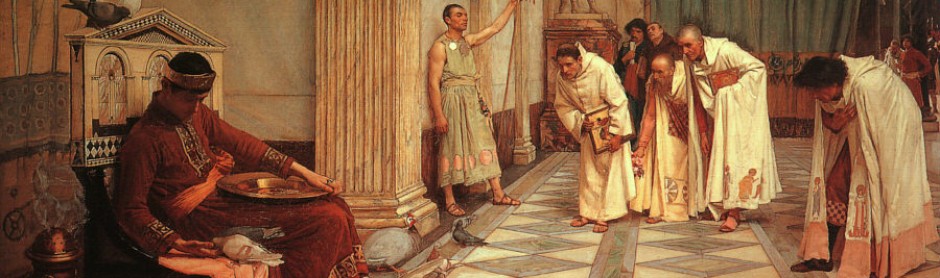
1. Simonides’ epitaph on the 300 Spartans who died at Thermopylae:

ὦ ξεῖν᾿, ἀγγέλλειν Λακεδαιμονίοις ὅτι τῇδε
    κείμεθα τοῖς κείνων πειθόμενοι νομίμοις.

Stranger, tell the Lacedemonians that we lie here, obedient to their laws/customs.

The epitaph appeals to the passerby to deliver the message because these men died and were buried far from Sparta: with no post offices or telephones in the ancient world, epitaphs for those who died away from home were often in the form “If you are ever in the town of X, tell Y the son of Z that his son is buried here, far from home”. The only way to send the message was to have it ‘hitchhike’ with someone who happened to be headed in the right direction. In this case, specific names are unnecessary.

Simonides was one of the greatest Greek poets, though little of his work survives — just enough to show us what we’re missing. He was particularly known for his elegies, epitaphs, and threnodies — all the gloomier genres — which were simple and moving. His epitaphs were written for the actual monuments, not as literary exercises. This is Simonides XXIIb in the Oxford Classical Text of Epigrammata Graeca and (with commentary) Further Greek Epigrams, both edited by D. L. Page. The meter is elegiac couplet. Other sources give the last two words as ῥήμασι πειθόμενοι, “obedient to their words”. However, whether he said that the Spartans were “obedient to the words” (= commands) of their kings or “obedient to the customs” of their country, it means that they were willing to follow orders without question even when there was no chance of survival. The word I have translated “obedient to” also means “persuaded by” — a nice example of small-d democracy in the very structure of the Greek language. The movie Go Tell The Spartans takes its title from Simonides’ epitaph, either directly or (perhaps through Cicero) indirectly.

2. Cicero’s paraphrase, from Tusculan Disputations 1.101:

Dic, hospes, Spartae, nos te hic vidisse iacentes
    dum sanctis patriae legibus obsequimur.

Stranger, tell Sparta that you saw us lying here, as we obey the sacred laws of our fatherland.

3. A. E. Housman, More Poems XXXVI:

Here dead we lie because we did not choose
    To live and shame the land from which we sprung.
Life, to be sure, is nothing much to lose;
    But young men think it is, and we were young.

The first two lines are a paraphrase of Simonides, generalized for all nations. The last two are Housman’s own addition, though the thought is very pagan and very Greek. Housman’s little poem achieves an impressive degree of Simonidean simplicity. Every word but two is monosyllabic, and even the exceptions hardly count, since ‘nothing’ was originally ‘no thing’ and ‘because’ originally (I think) ‘by cause’. It’s odd that a professional Latinist should write such a thoroughly unLatin poem: just about every word is pure Anglo-Saxon.
Posted in Greek Literature | Tagged , , , , | 1 Comment

Aphorism of the Day

El paganismo es el otro Antiguo Testamento de la Iglesia.

Paganism is the other Old Testament of the Church.

(Nicolás Gómez Dávila, Escolios a un Texto Implícito, 1.206)

Posted in - Aphorisms, Ephemerides | Leave a comment

Gluttony and Self-Knowledge

A link from Martin Kramer led me to two articles in the Chronicle of Higher Education by the pseudonymous ‘Thomas H. Benton’, The 7 Deadly Sins of Students and The 7 Deadly Sins of Professors. Here’s a bit from the first:

Gluttony: It hardly needs saying that most colleges struggle to control alcohol consumption by students and the embarrassing incidents and tragedies that result from it. But there are other manifestations of gluttony these days. For example, when did it become acceptable for students to eat and drink in class as if they were sitting in a cafeteria? Nowadays, I occasionally encounter a student who thinks it’s OK to consume a large, messy, and odorous meal in class. I once saw a student eat an entire rotisserie chicken, a tub of mashed potatoes with gravy, several biscuits, and an enormous soft drink during the first 10 minutes of a lecture. I felt like a jester in the court of Henry VIII. It seems hard these days to find a student in class whose mouth is not stuffed with food. Such students will often say that they have no other time to eat, but previous generations — who were no less busy — managed to consume small snacks between classes. That is why colleges have vending machines.

I don’t know when it became acceptable, but eating in class was not unheard of even thirty years ago. That was when I took a class on Aristotle’s Ethics at the supposedly-ascetic University of Chicago. One day, as we were discussing a chapter on one of the Greek virtues, we watched the plumpest student in the class scarf down three hot dogs and a 20-ounce soda in under 10 minutes, while doing most of the talking. He had some difficulty making himself understood, since his mouth was full the whole time. I’m sure I wasn’t the only one in the room who had to stifle the urge to say “what the Heck do you know about sophrosyne, you disgusting pig?”

Posted in Philosophy | 1 Comment

Aphorism of the Day

Las escuelas filosóficas fueron las órdenes monásticas de la antigüedad.
El pitagorismo, por ejemplo, se parece más a la reforma cluniacense que al idealismo alemán.

The philosophical schools were the monastic orders of antiquity.
Pythagoreanism, for example, has more resemblance to the Cluniac reform than to German idealism.

(Nicolás Gómez Dávila, Escolios a un Texto Implícito, 1.218)

Posted in - Aphorisms, Ephemerides, Philosophy | Leave a comment

Aphorism of the Day

El léxico del verdadero escritor no está en ningún diccionario.

The lexicon of the true writer is not in any dictionary.

(Nicolás Gómez Dávila, Escolios a un Texto Implícito, 1.137)

Posted in - Aphorisms, Ephemerides | Leave a comment

Aphorism of the Day

Hombre culto es aquel para quien nada carece de interés y casi todo de importancia.

An educated man is the one for whom nothing lacks interest and nearly everything lacks importance.

(Nicolás Gómez Dávila, Escolios a un Texto Implícito, 1.399)

Posted in - Aphorisms, Ephemerides | 1 Comment

Back-Handed Compliment

Ann Althouse is a law professor at the University of Wisconsin. Here is one of her posts from today, in full:

God bless the dork . . .

Overheard on State Street today:

“I said I would never go back to high school. But . . . I’m a dork. Every time, after Latin class, I’m so happy. And I just think, I want to feel like that all the time. I want to teach high school Latin.”

(That last paragraph should be doubly indented, with no quotation marks, but stupid WordPress refuses to accept nested blockquotes.)

Posted in Work: Teaching | 1 Comment

Ephemerides

As some of you have noticed, I have been unable to keep up my Joke of the Day (Ioci Antiqui) feature. As a partial substitute, I have set up the last of the categories in the left-hand column: Ephemerides, with four subcategories so far. I will try to post something in at least one of the subcategories every day, hence the name. Readers can see all the Aphorisms, Epigrams, or whatever by clicking on the individual subcategory, or all of them by clicking on Ephemerides. Further subcategories may be added, including perhaps Jokes. I hope to reorder all the subject archives into categories and subcategories for easier retrieval, but this may take a while.

Posted in Ephemerides | Leave a comment

Fragmentary Wisdom

Euripides, Fragment 1018 Kannicht, from an unknown play:

ὁ νοῦς γὰρ ἡμῶν ἐστιν ἐν ἑκάστῳ θεός.

For in each of us our mind is a god.

Posted in - Fragments, Ephemerides | Leave a comment

Any Questions?

The Rat wants a feminine equivalent of ‘avuncular’. That’s easy: ‘materteral’. According to the Random House Word of the Day site, the word is listed only once in the Oxford English Dictionary, but is actually older (1823) than ‘avuncular’ (1831). They also note that Latin had different words for aunts and uncles on the father’s and mother’s side of the family: you father’s brother and sister are your patruus and amita, your mother’s are your avunculus and matertera.

They do not note that the etymologies of three of these are transparent: your patruus is a second father (pater), your matertera a second mother (mater), and your avunculus a lesser grandfather (avus). In Anthropology and Roman Culture. Kinship, Time, Images of the Soul (tr. J. Van Sickle, Johns Hopkins, 1991), Maurizio Bettini gathers the evidence that the father’s siblings were “were expected to maintain an attitude of discipline, harshness and aloofness”, while the mother’s were stereotypically “warm and affectionate even to the point of indulgence” (both quotations from Matthew Slagter’s review, here). It appears that The Rat will soon be an amita rather than a matertera, but ‘amital’ is not an English word, and I imagine she’s planning to be more materteral anyway. I recently learned that I will soon be a patruus magnus (great-uncle), but I plan to defy the etymologies and be greatly avuncular.

Posted in Etymology | Leave a comment

The Last of Timon’s Last Words

Book VII of the Greek Anthology includes a sequence of eight supposed epitaphs of Timon of Athens, the famous misanthrope, epigrams 313-320. Having already posted seven of them, here is the eighth, by “Zenodotus or Rhianus” (A.P. 7.315), with W. R. Paton’s Loeb translation:

Τρηχεῖαν κατ᾿ ἐμεῦ, ψαφαρὴ κόνι, ῥάμνον ἑλίσσοις
    πάντοθεν, ἢ σκολιῆς ἄγρια κῶλα βάτου,
ὡς ἐπ᾿ ἐμοὶ μηδ᾿ ὄρνις ἐν εἴαρι κοῦφον ἐρείδοι
    ἴχνος, ἐηεμάζω δ᾿ ἥσυχα κεκλιμένος.
ἦ γὰρ ὁ μισάνθρωπος, ὁ μηδ᾿ ἀστοῖσι φιλἠεὶς
    Τίμων οὐδ᾿ Ἀΐδῃ γνήσιος εἰμι νέκυς.

Dry earth, grow a prickly thorn to twine all around me, or the wild branches of a twisting bramble, that not even a bird in spring may rest its light foot on me, but that I may repose in peace and solitude. For I, the misanthrope, Timon, who was not even beloved by my countrymen, am no genuine dead man even in Hades.

Posted in - Epigrams, Ephemerides | 1 Comment