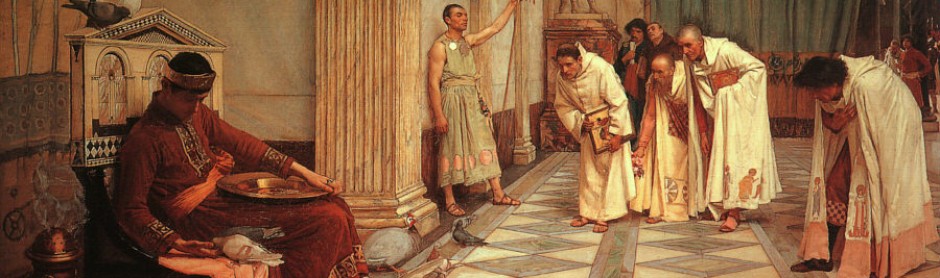
An Unlikely Source

Facts about the ancient world, even when mentioned in ancient texts, are not always found in the texts we would think of consulting first, or second, or at all. In his commentary on Martial I, Peter Howell refers (205) to Philodemus, On Methods of Inference (II.3f., if anyone wants to look it up) as the source for a list of “celebrated dwarfs (Egyptian, and possibly Syrian)”. What dwarfs and their names have to do with formal logic is not obvious, though I’m not quite intrigued enough to try to find out.

Posted in Latin Literature, Philosophy | Tagged | Leave a comment

Little-Known Fact: BBC Shakespeares

Amazon and other retailers offer four BBC Shakespeare DVD box sets, of five plays each: Comedies, Histories, Tragedies, and Tragedies II. The list price is $149.99 per box, and Amazon doesn’t discount them nearly as much as most of their DVDs. As I write, the Amazon prices are $134.99 for two of them, $129.99 for the other two, which is as low as I’ve ever seen them. To judge from the thre I’ve seen, they are excellent productions, but $529.96 plus shipping for 20 plays is an awful lot of money, and the seventeen plays not available include some of those I most wanted to see — not least because they are exactly the ones I’m unlikely ever to see in a theater.

There is a simple solution, which I owe to a former colleague I’ll call ‘Dr. Johnson’ for his erudition. Amazon UK sells all 37 canonical plays in a big box for a lot less. When I bought them in May, the price was $238.11, including air-freight shipping: they arrived in six days. The Sterling price must have been £115 or so. As I recall, it was £130, and they subtracted £15 for VAT tax since it was being shipped to North Carolina, were we are not eligible for the VAT-funded National Health. The exchange rate has worsened a bit since then, but the Sterling price is now £99,98 including (I assume) VAT. However you calculate it, buying all 37 plays from Amazon UK costs less than half of what it costs to buy only twenty of them from Amazon US. I wonder if it was the BBC’s idea to soak the colonists? Of the three I’ve watched so far, the best (Winter’s Tale and The Merchant of Venice) are not available in the U.S. (The other is Julius Caesar: not bad, but it didn’t grab me like the other two.)

Of course, you will need a Region 2 or all-region DVD player to play the discs, but even a better-than-average all-region DVD player cost me only $170. It will be useful for more than just BBC Shakespeare. Other movies not available in region 1 versions include three Bergman movies from the U.K. with English subtitles and the Orson Welles Shakespeares (Othello, Macbeth, and Chimes at Midnight) with South Korean subtitles. Even some American movies are only available in Region 2: until the Criterion edition came out a few weeks ago, Jim Jarmusch’s Night on Earth was only available in a U.K. edition. I’m so glad ‘Dr. Johnson’ told me about the Amazon UK edition before I bought any of the U.S. boxes.

Posted in Culture: Plays, Movies, Nachleben | 1 Comment

Seneca Commentaries

I’ve updated the list of twentieth-century commentaries and other works on Seneca’s Epistulae Morales (link on the left) with four or five recent works. It’s a busy field, though there are still three dozen letters in which the reader is on his own except for the occasional notes in the Loeb and Budé translations, neither recent.

Posted in Commentaries, Latin Literature | Tagged | 2 Comments

Overheard while Waiting to Take the PRAXIS Latin Test

Dramatic dialogue recounted by a man who teaches in a small town in the country (T = teacher, S = student):

T. What’s 60 divided by 15?
S. Four.
T. What’s 15 divided by 60?
S. We can’t do that, moron!
T. You’re twenty years old, still in high school, taking a course designed for 13-year-olds, and failing it, and I’m the moron?

I assume the last line is what he would have liked to say in retrospect, or what he did say under his breath, rather than something he actually said out loud to the student’s face.

Posted in Teaching | 1 Comment

Fielding Translates Silius

Silius Italicus doesn’t have much of a Nachleben, but here’s a translation of Punica 2.217-221 from The Complete Works of Henry Fielding, Esq., edited by James P. Browne (London, 1903), Volume XI, page 155:

            A Simile from Silius Italicus

Aut ubi cecropius formidine nubis aquosae
Sparsa super flores examina tollit Hymettos;
Ad dulces ceras et odori corticis antra,
Mellis apes gravidæ properant, densoque volatu
Raucum connexæ glomerant ad limina murmur.

Or when th’ Hymettian shepherd, struck with fear
Of wat’ry clouds thick gather’d in the air,
Collects to waxen cells the scatter’d bees
Home from the sweetest flowers, and verdant trees;
Loaded with honey to the hive they fly,
And humming murmurs buzz along the sky.

Posted in General, Latin Literature, Nachleben | Leave a comment

Dubious Historical Claim of the Day

InstaPundit links to a story from the Knoxville News about Tina, a Shire breed horse claimed to be the world’s tallest. The dubious historical claim is half a sentence: “Shires date to the Trojan War . . . .” What possible evidence could support that claim?

Posted in Greek Literature, Nachleben | Tagged | 3 Comments

More Wilkie Collins

Some quotations from The Guilty River (1886):

1. The hero’s stepmother describes their Member of Parliament, who has been unlucky in love (VI):

“. . . quite broken-hearted about Lady Lena; gone away to America to shoot bears.”

2. The hero on himself (VII):

The habits that I had contracted, among my student friends in Germany, made tobacco and beer necessary accompaniments to the process of thinking. I had nearly exhausted my cigar, my jug, and my thoughts, when I saw two men approaching me from the end of the terrace.

3. The (very handsome, and deaf) villain addresses the heroine (XIII):

“Are you one of the few women who dislike an ugly man? Women in general, I can tell you, prefer ugly men. A handsome man matches them on their own ground, and they don’t like that. ‘We are so fond of our ugly husbands; they set us off to such advantage.’ Oh, I don’t report what they say; I speak the language in which they think.”

4. The hero again (XVII):

When the detective police force encounters intelligence instead of stupidity, in seven cases out of ten the detective police force is beaten.

Here are two more quotations from A Rogue’s Life (1856), which I read a few weeks ago:

5. The rogue-narrator lists the principal categories of “professedly hard-hearted persons” who will be uninterested in the story of his love for the heroine (VII):

. . . monks, misogynists, political economists . . .

6. One of the more surprising bits of A Rogue’s Life was the parenthetical description of “a frugal curate’s dinner” (XII):

. . . bit of fish, two chops, mashed potatoes, semolina pudding, half-pint of sherry . . .

That seems like quite a lot for one frugal meal. Perhaps the chops were very small.

Posted in Culture: Fiction | Leave a comment

Latin or Pseudo-Latin?

Colby Cosh writes: “I guess I’m the only news editor alive who isn’t busy reading about horcruxes.” I haven’t read the books or seen the movies, and have no plans to do either, but shouldn’t that be ‘horcruces’?

Posted in Orbilius | Leave a comment

One Reason I Prefer the Classics

The theory taught in graduate schools of modern literature is like mortadella: it’s expensive, imported, beautifully packaged, made with loving care by experts who have devoted their lives to their work and do it very well . . . but it’s still bologna.

Posted in - Aphorisms | 1 Comment

Beyond Bibliophilia

She herself was a victim of that lust for books which rages in the breast like a demon, and which cannot be stilled save by the frequent and plentiful acquisition of books. This passion is more common, and more powerful, than most people suppose. Book lovers are thought by unbookish people to be gentle and unworldly, and perhaps a few of them are so. But there are others who will lie and scheme and steal to get books as wildly and unconscionably as the dope-taker in pursuit of his drug. They may not want the books to read immediately, or at all; they want them to possess, to range on their shelves, to have at their command. They want books as a Turk is thought to want concubines–not to be hastily deflowered, but to be kept at their master’s call, and enjoyed more often in thought than in reality.

(Robertson Davies, Tempest-Tost, Chapter 6)

Posted in General | 1 Comment

Riddle

Why would ‘Noel’ be the most appropriate name for a priest’s pet parakeet?

Posted in General, Jokes | Leave a comment

The Value of a First-Class Education

What one British rogue learned at school in the early 19th century:

. . . I was sent to one of the most fashionable and famous of the great public schools. I will not mention it by name, because I don’t think the masters would be proud of my connection with it. I ran away three times, and was flogged three times. I made four aristocratic connections, and had four pitched battles with them; three thrashed me, and one I thrashed. I learned to play at cricket, to hate rich people, to cure warts, to write Latin verses, to swim, to recite speeches, to cook kidneys on toast, to draw caricatures of the masters, to construe Greek plays, to black boots, and to receive kicks and serious advice resignedly. Who will say that the fashionable public school was of no use to me after that?

(Wilkie Collins, A Rogue’s Life, Chapter I)

Posted in Culture: Fiction, General | Leave a comment

Signs

I’ve been in Staunton, Virginia, for some Shakespeare at the Blackfriars Playhouse — more on that later. For now, I’ll just post about some interesting signs seen along the way:

  • Sign that looks like it’s missing a letter: Grim Realty.
  • Sign overtaken by events to produce an unfortunate ambiguity: (on the back of an ambulance) S.A.R.S. Ambulance. I imagine that stands for Staunton Area Rescue Service, or something like that, but the tinfoil-hat crowd might think we now have special ambulances for Severe Acute Respiratory Syndrome, the deadly flu which killed over 700 people in China, Canada, and other countries four years ago.
  • Surprisingly accurate sign: Every city in America seems to have an ‘Oak Grove Road’, and I’ve never seen an oak grove anywhere near any of them. I’m no dendrologist, and I passed rather quickly, but it looked to me like the Oak Grove Baptist Church near Farmville is located in an actual grove of oak trees. That shouldn’t have surprised me, but it did.
  • Least expected message on a sign: Goat Milk Soap, next right.
Posted in General | Leave a comment

Ponderings of a Fictional Fop

Ambrose Silk, September 1939:

It is a curious thing, he thought, that every creed promises a paradise which will be absolutely uninhabitable for anyone of civilized taste. Nanny told me of a Heaven that was full of angels playing harps; the Communists tell me of an earth full of leisured and contented factory hands. . . . . Religion is acceptable in its destructive phase: the desert monks carving up that humbug Hypatia, the anarchist gangs roasting the monks in Spain. Hellfire sermons in the chapels; soap-box orators screaming their envy of the rich. Hell is all right. The human mind is inspired enough when it comes to inventing horrors; it is when it tries to invent a heaven that it shows itself cloddish. But Limbo is the place. In Limbo one has natural happiness without the beatific vision; no harps; no communal order; but wine and conversation and imperfect, various humanity. Limbo for the unbaptized, for the pious heathen, the sincere sceptic.

(Evelyn Waugh, Put Out More Flags, Chapter I.7)

Posted in Culture: Fiction, General | 2 Comments

Two Things I Didn’t Know

My school has a ‘service day’ every semester, when students are sent out to do good works of various kinds. Tomorrow, high-schoolers over 16 will be demolishing a house for Habitat for Humanity, while those under 16 (HforH has an age minimum) build a wheelchair ramp somewhere else. On Tuesday, the middle-schoolers washed cars for Wheels 4 Hope, a charity that refurbishes donated cars and gives them to needy families. I learned two interesting things on Tuesday:

1. A lot of middle-schoolers don’t consider washing cars in 90-degree heat to be work at all, as long as they can wear cutoffs or bathing suits and have control over the hoses. One of the 7th-grade girls convinced several of her classmates to go over to her house right after school and help wash all the family cars.

2. Until a few weeks ago, I had been driving a ’95 Tercel that has been bashed in twice on each side. (Three of the four bashes were done by hit-and-run drivers in the six months I lived in New York City, one while I was in the car by a guy in a pickup truck who threatened to kill for not yielding to him — he had a yield sign, I didn’t.) The driver’s seat is mostly bare foam, and there are several other things wrong with the car, but it runs and passes inspection, so it must be worth something. One of the school administrators had been suggesting that I give the Tercel to Wheels 4 Hope now that I’ve acquired a better car. When she came back from the car wash, she told me she doesn’t think it’s up their standards. Not a problem: I already had other plans for it.

Posted in Teaching | Leave a comment

Cruel, But Not Unusual

Many of my students — especially a couple of 7th-grade boys — show a great deal of interest in ancient forms of capital punishment. Today I put together a model to illustrate the Athenian practice of apotumpanismós, or ‘planking’, which is essentially crucifixion without the nails (paradoxically, that makes it crueler):

The text on the lower left reads:

CRUEL, BUT NOT UNUSUAL
Ancient Athenian Capital Punishment

Stephen (Stéphanos) is a thief, caught in the act. His punishment is apotympanismós (‘planking’). He has been fastened to a wooden plank with five metal hoops and left out in the sun to die of hunger, thirst, heat, cold, and the nibbling of wild animals and birds. There are guards to keep his friends from releasing him or giving him food or water, but his enemies are free to come and abuse him whenever they like. If he were a major criminal like a traitor, he would have been thrown in the Bárathron, a deep pit near Athens, his body left there to rot and be eaten by vultures. Stephen will get a decent burial after he dies, though that may take a week or more.

That’ll teach Stephen to steal Barbie’s purse. It’s too bad about the hair-style — and the silly happy look on his face.

Next project: the Bárathron. That will take a bit more money, but will be easy enough. Take one large-sized plastic garbage can, add a small shelf on one side at the top, line the interior and the shelf with papier-maché to represent bare rock, add a fully-clothed Ken and Barbie throwing a loin-cloth’d Stephen over the edge, and put the pieces of another Stephen down in the bottom, with the broken-up remains of a couple of plastic skeletons, if I can find them in the right size. Bushes and vultures are optional, though they would add a bit of atmosphere. I’ll probably enlist my students to work on that, since their experience with papier-maché is undoubtedly fresher than my own (by 40 years or so, I estimate).

Posted in Teaching | Tagged , | 3 Comments

About the Author

If InstaPundit can post a portrait of himself drawn by a two-year-old nephew, I suppose I can post a portrait of me done by the youngest of my sixth-grade Geography and Latin students:

I like the way it gives the short person’s perspective, while taking thirty or more years off my age. On the other hand, my ears are not quite that prominent.

Posted in General, Work: Teaching | 2 Comments

Food for Thought

One of the great ironies of the Internet age is that traditional ephemera, such as newspaper articles and diary entries, now live on forever in indexes and blogs. Meanwhile, given the short shelf life of modern books — basically, six weeks nowadays — and the decline of traditional library stacks, modern books only live on for a few years at most. Indeed, if you really want your prose to survive this century, you might be better off writing a successful blog that enjoys a lot of technorati links.

— Michael S. Malone (here)

Posted in General | Leave a comment

Emendations ‘R’ Us

Eve Tushnet has a top-ten post on horror in pop songs. Unfortunately, I’ve never heard of any of the songs, and only one of the performers – Siouxsie and the Banshies – who was (were?) the object of a Beavis & Butt-Head text-and-commentary segment. The last title on the Tushnet list is a song by the Cramps (whoever they are) called “Eyeball in my Martini”. My split-second reaction was “shouldn’t that be ‘Eyeball in my Highball’?”. A Google search shows that a song by that name has already been written, and is available for 50¢ from Lulu. I haven’t decided yet whether to pay for a copy.

Posted in Music, Work: Editing | 1 Comment

Musical Snark

Charles Rosen, The Classical Style, p. 170:

It was Handel who said that Gluck ‘knows no more counterpoint than my cook’ . . . Tovey has pointed out that Handel’s cook, who was also a singer in Handel’s opera company, probably knew a good bit of counterpoint.

Posted in Music | Leave a comment